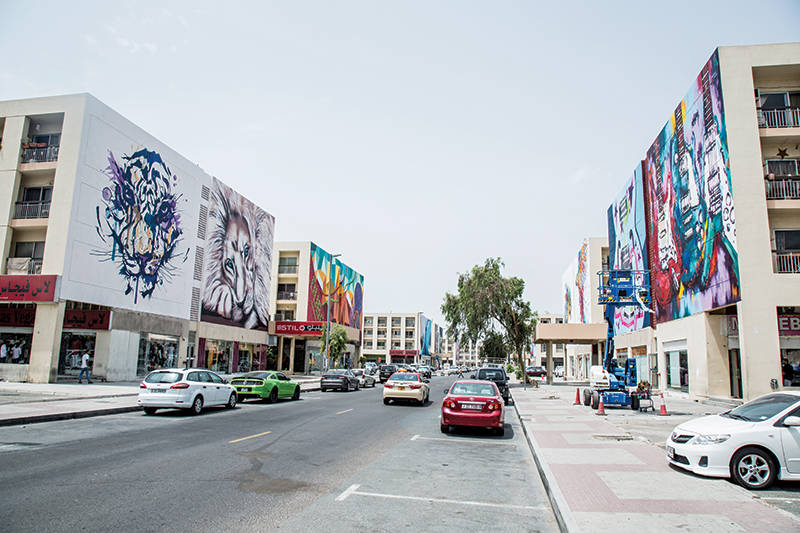
Need a change in scene? Round up the family, jump in the car and drive to these spots in the city and check out the wonderful street art.
Source: Here’s where you can find awesome street art in Dubai
Authors in the Tent is a professionally filmed series of interviews with established and emerging authors conducted in a tent Ona Russell purchased during the pandemic. Inspired by Boccaccio’… Source: David L. Ulin on How Walking Is an Act of “Re-Creation” ‹ Literary Hub
You can explore Brooklyn history with guided wanders through four neighborhoods this month, hosted by the Municipal Art Society. Source: Stroll through Brooklyn history with this month’s Municipal Art Society walking tours • Brooklyn Paper
If you can’t spare a week to walk Britain’s mountain trails, coastal tracks and riverside paths, head for these expert-picked highlights Source: The best of the UK’s most epic walking trails in 2-3 days | United Kingdom holidays | The Guardian
Need a change in scene? Round up the family, jump in the car and drive to these spots in the city and check out the wonderful street art.
Source: Here’s where you can find awesome street art in Dubai
pedestrian acts
By de Certeau: In “Walking in the City”, de Certeau conceives pedestrianism as a practice that is performed in the public space, whose architecture and behavioural habits substantially determine the way we walk. For de Certeau, the spatial order “organises an ensemble of possibilities (e.g. by a place in which one can move) and interdictions (e.g. by a wall that prevents one from going further)” and the walker “actualises some of these possibilities” by performing within its rules and limitations. “In that way,” says de Certeau, “he makes them exist as well as emerge.” Thus, pedestrians, as they walk conforming to the possibilities that are brought about by the spatial order of the city, constantly repeat and re-produce that spatial order, in a way ensuring its continuity. But, a pedestrian could also invent other possibilities. According to de Certeau, “the crossing, drifting away, or improvisation of walking privilege, transform or abandon spatial elements.” Hence, the pedestrians could, to a certain extent, elude the discipline of the spatial order of the city. Instead of repeating and re-producing the possibilities that are allowed, they can deviate, digress, drift away, depart, contravene, disrupt, subvert, or resist them. These acts, as he calls them, are pedestrian acts.
Encountered a problem? Report it to let us know.
You must be logged in to post a comment.