Search
My feed

Curated News

Collection · 1061 items

Related

Curated news

Art, “walking through clouds” to look at the world from above – ilSole24ORE

“Walking through clouds” in The Hague, or admiring daily objects elevated to artworks: shows in the Netherlands to enjoy before summer ends. Source: Art, “walking through clouds” to look at the world from above – ilSole24ORE

Curated news

Hope Corps Downtown Mural Project — Visit Seattle

The Hope Corps Downtown Seattle Mural Project represents a partnership with the Office of Economic Development and six trusted downtown neighborhood organizations. There are over 20 murals spanning from SODO to Belltown, to celebrate Downtown Seattle’s vibrant arts, culture, and entertainment. Each organization worked with local artists to design beautiful pieces of art that create

Curated news

Don’t Call It a Protest. It’s a Walk for Radical Love. – The New York Times

María Magdalena Campos-Pons is marshaling New Yorkers for unity, linking uptown and downtown communities while highlighting inequities in city parks. Source: Don’t Call It a Protest. It’s a Walk for Radical Love. – The New York Times

Curated news

Alberto Tandoi walked 400km across London and photographed all of the people who caught his eye

The Italian photographer describes his new photobook as a “collection of silent stories”. Source: Alberto Tandoi walked 400km across London and photographed all of the people who caught his eye

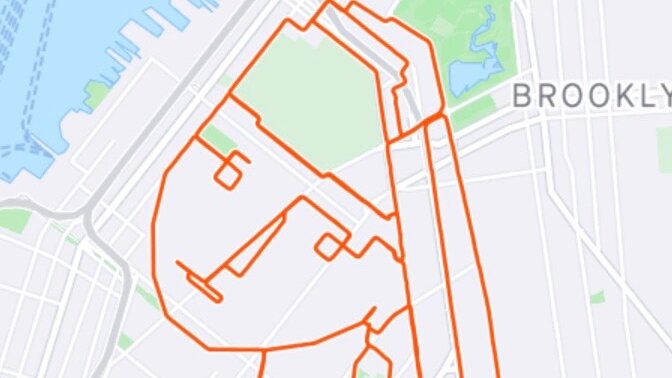
Runners and Cyclists Use GPS Mapping to Make Art – The New York Times

Fitness apps and the power of live satellite tracking have allowed runners, cyclists and others to draw hearts, animals, birthday wishes — and even homages to Vermeer — across their local landscapes.

Source: Runners and Cyclists Use GPS Mapping to Make Art – The New York Times

Submitted by: Babak Fakhamzadeh

pedestrian acts

By de Certeau: In “Walking in the City”, de Certeau conceives pedestrianism as a practice that is performed in the public space, whose architecture and behavioural habits substantially determine the way we walk. For de Certeau, the spatial order “organises an ensemble of possibilities (e.g. by a place in which one can move) and interdictions (e.g. by a wall that prevents one from going further)” and the walker “actualises some of these possibilities” by performing within its rules and limitations. “In that way,” says de Certeau, “he makes them exist as well as emerge.” Thus, pedestrians, as they walk conforming to the possibilities that are brought about by the spatial order of the city, constantly repeat and re-produce that spatial order, in a way ensuring its continuity. But, a pedestrian could also invent other possibilities. According to de Certeau, “the crossing, drifting away, or improvisation of walking privilege, transform or abandon spatial elements.” Hence, the pedestrians could, to a certain extent, elude the discipline of the spatial order of the city. Instead of repeating and re-producing the possibilities that are allowed, they can deviate, digress, drift away, depart, contravene, disrupt, subvert, or resist them. These acts, as he calls them, are pedestrian acts.

Problem?

Encountered a problem? Report it to let us know.

  • Include the page on which you encountered the problem.
  • Describe what happened.
  • Describe what you expected to happen.
Follow us