


Arctic
In this collection

Highlights

Artic Sound Walk – Horatio Clare BBC Radio 3 Slow Radio – 3×15′ episodes – only days left to listen
Freezing and Finding Episode 1: With a rich, varied and immersive listening experience, in the latest of his Slow Radio Sound Walks, as the winter draws and the snows threaten, Horatio Clare follows Greenland’s Arctic Circle Trail from the west coast of the country towards the vast ice-sheet. In a series of alien worlds, the
 •

Articles elsewhere
Fairytale
He built himself a house, his foundations, his stones, his walls, his roof overhead, his chimney and smoke, his view from the window. He made himself a garden, his fence, his thyme, his earthworm, his evening dew. He cut out his bit of sky above. And h...

Endings – 17/18 October 2017 – back to the begining
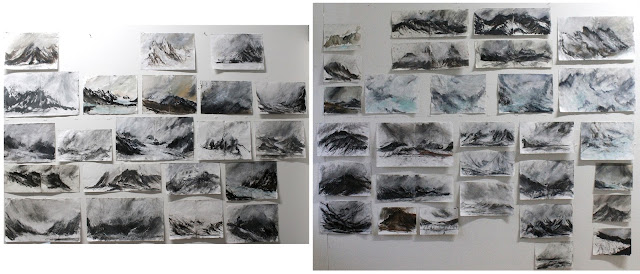
Monday 17/10/2016 8°C, light wind 2m/s, overcast, low fog. Sunrise 10:49 - Sunset 16:34 Early morning we take leave ofPyramiden. In dark grey green sea ruffled by a light wind, I watch the glimmer of dawn appear over mountain tops, the moon still hanging above us. I stand on deck watching mountains and glaciers passing, and the last time most of us will pass this way for a while. We are all subdued. A few hours later we sail into Longyearbyen and moor up. 78°13.7´N, 015°36.3´E; we’re back and it’s the end of the expedition.After the chaos of packing and disembarking, pulling luggage back up the steps of the hostel, I retire to the peace and warmth of the Miner’s Bar for a cup of hot chocolate topped with cream. So we are back in civilization; people and cars and shops, even if it looks far more insubstantial than brick-built Pyramiden. In two weeks time the sunlight will disappear and there will be darkness here for the next few months. Even now the sun doesn't clear the tops of the surrounding mountains, and the amount of daylight is less and less each day. Back outside I walk to the top of town with my kite (ever hopeful), to where the road disappears into wildness and polar bear territory. There’s a suggestion of wind so I find a relatively flat space amongst the rocks and lay out the strings, untangling them, which takes a while. Turning on my GoPro I walk back and launch it into the air; a few seconds later it falls to the ground, the wind has gone. Frustration, my verbal responses disappear into the ether; fortunately there’s no-one around. I try again but by now the strings are stuck to the permafrost ground and snag on rocks. I give up; it's really not going to happen. I think that maybe I should have gone with the helium balloon idea. Too late now. A drone would have been even easier - but where's the challenge in that? Instead I wander down town and visit the local art gallery to discover a selection of old maps of the Arctic, complete with illustrations of past activites and creatures to be found in the waters of Svalbard.An old book jacket shows the preconceptions that most people held of the region - as a bleak, dangerous, inhospitable terrain of ice and rock - the borders of the known world. -->It’s trying to snow/rain. Everyone is remarking that it is far too warm for this time of year. Where is the snow? In the night the snow comes.Tuesday October 18th Climbing high. Making our way over boulders and loose rocks, pools of ice and snow, we head up into a blanket of white. We are climbing the mountain at the far end of town. A steep gully on one side falling into a snow-covered glacier at the bottom; I glimpse a glimmer of blue ice at the edges, a monochrome landscape rising and disappearing in front of us. Strips of brown-black and white, small peaks rise out of mist, smooth white slopes and edges, and lots of snow. I dare not look down, keeping my balance more by luck than skill. Ahead Sarah, her rifle at the ready (just in case), keeps up a fast pace; we follow in single file. Sarah Gerats, our guide, and Nemo, surveying from the topReaching the cairn at the summit level with the tops of mountains, we stand surveying a world of whiteness. The air feels wonderfully pure and cold. Below us Longyearbyen is a map of textures and lines.It's as though I’m in the midst of an abstract drawing - how can I compete on paper?Summit posingLater in the dark we gather together under a street-light and take turns to read a few lines of prose/poetry. I read:‘There is hardly anything that shows the short-sightedness or capriciousness of the imagination more than traveling does. … We measure the universe by ourselves… We remember an infinity of things and place… Out there we can experience the new, even if such knowing means only to touch at nature’s vast strangeness’ (taken from Henry David Thoreau, ‘Redemptive Imagination’ – on Walking, written in mid 1850’s).Walking… thinking… drawing… erasing… overdrawing… pausing…erasing… pausing… time slipping… remembering space… silenceHere is a link to the poetry reading held in Longyearbyen, 78 degrees north, October 2016 organised by Ersi Sotiropoulos as a part of the World Poetry Movement's Global Action:https://www.youtube.com/watch?time_continue=9&v=lghwVlimvd4 In his introduction to ‘The Idea of North’, Glen Gould, a Canadian artist, writes:“Something really does happen to most people who go into the north—they become at least aware of the creative opportunity which the physical fact of the country represents and - quite often, I think - come to measure their own work and life against that rather staggering creative possibility: they become, in effect, philosophers". Postscript….. Trying to absorb and grapple with all this, and then make work has been interesting – challenging. In my studio I have the mass of drawings and paintings I made whilst traveling. Some of the things I attempted to do didn’t come off - like all those early attempts to fly in the Arctic (in their case their aim was to reach the north pole) my attempts at flying a kite with a camera failed - it was either too windy or no wind or it was raining or snowing or there were Walruses, or the strings stuck to the permafrost… Using ice with frozen watercolour pigments sort-of worked; what I produced was ephemeral and that’s okay since it was all experimental and will feed future work. --> but perhaps also partly relates to Arctic melting. The impact of the landscape, its sheer scale was pretty - to employ a word that the Americans used a lot – awesome! And it was certainly immersive. How to convey all this in a moment on a piece of paper I’m still trying to figure it out. I can still feel the frustration of trying to draw a series of peaks with the mist moving over them - to get at least something down on the paper. In my notes I wrote ‘I can’t put down what I’m seeing… it seems quite insane to be trying’. My notes are full of colour descriptions… ‘white isn’t white, white is many whites’… Work will emerge in the coming year, so watch this space…Thank you all for your support
 •
16 Oct 2016 – Pryamiden and the furthest north Lenin
Sunday 16/10/2016 -2°C, 5m/s. Sunrise 10:39 - Sunset 16:45.Late Saturday night we arrive and anchor close to Pyramiden 78°39.2´N, 16°22.9´E.Emerging onto an icy deck in crisp blue morning light, the moon still hangs over a now completely calm sea. In front of us the abandoned Russian settlement of Pyramiden sits silently at the foot of the snow-capped Pyramid Mountain. Once a model coal mining town until the fall of the Soviet Union in the late 1980s, it still bears the scars of its mining days. In 1936, the Soviets acquired the rights to use the coalfields at Pyramiden and built the town to demonstrate Soviet power.Lenin's viewThe Russian government threw money at this place, even importing earth from the Ukraine so there would be grassy areas on top of the permafrost. Once there were green houses full of vegetables, hens laying eggs. A place where only the best coal miners and their families could work.It was desirable to live here - life was relaxed away from Mother Russia, people had more freedom. Any foreigner could come here without a visa, and it must of been impressive.In the 1980s more than 1,000 people lived in Pyramiden. Residents were assigned to different residential halls, which acquired their own nicknames - London for single men, Paris for the unmarried women (there was even pub on the ground floor of the women's building). Crazy House for families , so called because the children who would always play in the hallways. Gostinka (Russian for “hotel,”) was built to house short-term workers. There was a hospital, a large cafeteria - apparently so that the women didn't have to cook for their families and therefore could be useful workers (!) - a giant mosaic was made depicting the Svalbard landscape populated by heroes of Norse legends. Apparently the heated indoor pool was the best in Svalbard. All was constructed in typical Soviet block-style fashion of brick made on site with rounded edges to lessen the impact of the bitter winter wind. Somewhere there is even a grave yard for both humans and cats.Now blocks of abandoned flats where mine workers and their families once lived, are now colonised by kittiwakes. It''s difficult to imagine this waste land full of industry; I try to imagine families wandering the boardwalks on a summer evening. At top of town in front of the Culture House the northern-most bust of Lenin surveys empty streets and dilapidated buildings. We wander around the Culture house; inside is full of abandoned items - sets of old skis, a football lies in the sports court, the empty goals still in place - when was the last game? Russian books and pamphlets, old photographs of people who once lived and worked here. The world's northern-most grand piano - a "Red October" - sits on the stage in the dark and deserted auditorium. Jordi mounts the stars, sits and plays, the out-of-tune sound echoing eerily through the building. On the wall in a room upstairs is a panorama depicting the surrounding mountains. Who painted it? Rotting wooden walkways and bridges, huge mounds of scrap metal lie beside the dock juxtaposed with bright soviet monuments that reach for the sky proclaiming power. Its a pretty horrible mess but the setting surrounded by snow capped mountains, the Nordenskiöld glacier and fjord to the east, is magnificent. Waking to this everyday as you went to work - would you ever get used to it? But then the mine workers would spend their days in darkness, deep inside the mountain, to emerge into either the darkness of a polar night or blinking into the brilliant light of the summer season. Rusting swings sit in the playgroundWith the fall of the Soviet Union the money dried up, wages stopped being paid, there were shortages and standard of living fell, so families left. The town was abandonded. On March 31,1998, the last coal was extracted from the mine; seven months later, just before the ice arrived, on October 10th the last residents left. Pyramiden has now become, or they are attempting to make it, a tourist destination with a hotel staffed by a couple of Russians where visitors can enjoy staying in a Russian style room or opt for more European comforts.The Hotel - Russian style Before we leave to get back for dinner I make a quick drawing of the Pyramide mountain rubbing chalk and graphite across the page smudged with the icy water running from the mountain. Not really enough time to do much before we return to the boat. Just beyond me on the path Jordi is filming Spike dressed as a polar bear and sweeping snow. Drawing the mountain, photo courtesy of Jordi ForniesThe Pyramiden mountain, photo courtesy of Jordi ForniesLater we troop along the board walks and return in the dark to the hotel and sit in the bar drinking vodka infused with horseradish and then another with ginger (both are pretty good), watching videos of folk dancing Russians bands. I find the contrast between all this and the surrounding landscape bizarre and also depressing. Must be very weird for the few remaining caretakers who live there all year in the midst of such decay, particularly during the dark months of Polar Night. The Arctic has a complicated history of exploitation - exploitation of natural resources. Its animals have been fished and hunted to virtual extinction, it’s been mined, claimed, land stolen, people destroyed by disease, and of course now there are global warming issues – the threat of ecological destruction of the planet. When I was interviewed by the anthropologist on board we talked about the north and I found myself relating these places to the wall in the series Game of Thrones holding back the Wildling hoards of the icy north who are threatening to invade and, like Janssen’s Groke, bring winter to the rest of the world. I feel that Longyearbyen and Ny Ålesund are like walls but doing the opposite to that in the Games of Thrones - or maybe not quite the opposite - instead are trying to protect the north, to prevent the world from invading the Arctic, guarding, drawing attention to its fragility – holding us back from inflicting more human exploitation and destruction.
• Fjortende Julibukta: wind-blown boat-rocked rain-spattered
--> Friday 14/10/2016 Fjortende Julibukta 4°C, 7m/s. Sunrise 10:20 – Sunset 17:04.Morning; grey gloomy light from an overcast sky. Grey green blue black sea a slightly swelling disturbed surface. Small chunks of glacier ice litter the sea. It rains all morning, so any thoughts of kite flying are abandoned (again) despite wind whipping across the water. We land and on shore I find a wooden structure - a make shift table; laying out my sketchbook and drawing materials and I have an outdoor studio. JK working on Fjortende Julibukta (photo by Annie)I draw and at the same time am desperately trying to hold everything down, wind and rain sweep the exposed beach, black ink is pushed and pulled across the page, spattering and running, obscuring images - impossible to do anything else but let it flow. I photograph the images as they disappear. My charcoal drawings fair little better. Disappearing drawingArtist's Arctic tableEverything is so wet. Time to move on and go get dry and warm. I walk back along the shore and watch a sea full of glacial ice slowly heaving, it's as though it's breathing. The pieces of ice have air, bits of rock and earth, plants embedded in them. How old are these particles? How far have they travelled? They're so beautiful - the blue colour of air trapped deep inside with orange brown earth and rock, even pinks, yellow green fragments of plants ripple through themBack to the boat in the gloom. I don’t think it stops raining all day, making for misty blue haze over the landscape. Undaunted I go out on deck and draw, and remain to work here all afternoon as others go back on land for a very wet trek around the glacier. I rush to make a quick charcoal drawing of the Fjortende glacier in front of the boat as the mountains disappearing into mist and rain, then, using the frozen pigments I created a few days ago, I smash chunks of coloured ice and throw them over the paper, allowing them to begin to melt and run across the sheets. The images are ephemeral again, ice dissolving with rain. Perhaps this is fitting given global warming and receding ice. The most interesting bit is probably photographing the changes – wind-blown boat-rocked rain-spattered. Later the sea is pale green grey with strips of yellow where rock meets water. With wind increasing, we remain in the bay with anchors down – it’s too strong outside to leave at the moment. Across the other side the lights come and go - a fishing vessel has joined our shelter. Midnight, from my tiny porthole the sea looks milky white, the boat rocking; think it’s going to be yet another night of little sleep.
•