Search
My feed

This is third party content.

In search of a horizon – with Sinéad in Dun Laoghaire

On my walk with Sinead along Dun Laoghaire pier she reflects on how walking this space provides her with the possibility of experiencing the therapeutic value of a horizon.

90
Harbour Plaza, Harbour Rd, Dún Laoghaire, Co. Dublin, Ireland Harbour Plaza, Harbour Rd, Dún Laoghaire, Co. Dublin, Ireland
Harbour Plaza, Harbour Rd, Dún Laoghaire, Co. Dublin, Ireland

walking it

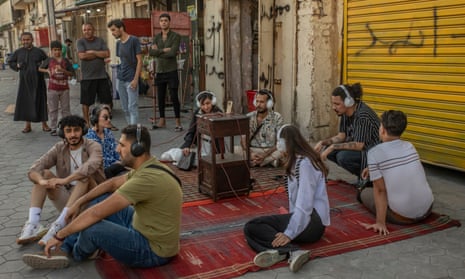
The SoundCloud profile "Walking It" features a curated collection of ambient and field recordings designed to enhance the experience of walking in urban and natural environments. The audio tracks emphasize the relationship between soundscapes and spatial awareness, capturing diverse acoustic atmospheres that range from quiet city streets to natural wilderness. This collection offers listeners an immersive auditory exploration of place, encouraging an attentive engagement with the sonic textures that define different walking routes. In addition to standalone soundscapes, "Walking It" includes experimental compositions that blend environmental sounds with minimal electronic elements, reflecting contemporary approaches in walking art practice. The recordings invite reflection on the interplay between movement, environment, and sound perception, aligning with cultural geography themes that consider how auditory experiences shape our understanding of place and mobility. Through this focus on walking as a method of experiencing and interpreting landscape, the profile contributes to the discourse on walking as an artistic and spatial practice.
Horizon

Collection · 1 items

reflection

Collection · 27 items

Regions

Dún Laoghaire

Neighbourhood · 1 items

pedestrian acts

By de Certeau: In “Walking in the City”, de Certeau conceives pedestrianism as a practice that is performed in the public space, whose architecture and behavioural habits substantially determine the way we walk. For de Certeau, the spatial order “organises an ensemble of possibilities (e.g. by a place in which one can move) and interdictions (e.g. by a wall that prevents one from going further)” and the walker “actualises some of these possibilities” by performing within its rules and limitations. “In that way,” says de Certeau, “he makes them exist as well as emerge.” Thus, pedestrians, as they walk conforming to the possibilities that are brought about by the spatial order of the city, constantly repeat and re-produce that spatial order, in a way ensuring its continuity. But, a pedestrian could also invent other possibilities. According to de Certeau, “the crossing, drifting away, or improvisation of walking privilege, transform or abandon spatial elements.” Hence, the pedestrians could, to a certain extent, elude the discipline of the spatial order of the city. Instead of repeating and re-producing the possibilities that are allowed, they can deviate, digress, drift away, depart, contravene, disrupt, subvert, or resist them. These acts, as he calls them, are pedestrian acts.

Problem?

Encountered a problem? Report it to let us know.

  • Include the page on which you encountered the problem.
  • Describe what happened.
  • Describe what you expected to happen.
Follow us

A weekly dose of walking inspiration

One column, selected discoveries, and upcoming Open Calls. Free, once a week.