


Month: May 2017




Planetwalker
In 1971, two oil tankers collided in the fog beneath the Golden Gate Bridge. John Francis, a hippie living north of San Francisco in Marin County, caught a glimpse of the aftermath: oil coating the shore and volunteers trying to save dying birds. Those sights affected Francis deeply. He decided that by driving or even riding in petroleum-powered […]


Arctic Post – Thurs 13th Oct Fuglefjorden – how darkness and light are bound together
--> Thursday 13.10.2016 Fuglefjorden - how darkness and light are bound together-2°C, 3m/s. Sunrise 10:11 sunset 17.15. 9-10 m/sA pre-breakfast Zodiac trip has been planned; it’s still dark when I arrive on deck. Can’t see any stars yet, a luminous green sea and dark land mass is silhouetted against the sky. The group of early-morning risers clamber into the Zodiacs, and travel out into a sea of ice, leaning out to push large chunks of looming icebergs out of the way. The sea and ice heave slowly – almost as though breathing, ice turning and moving away. We get close to the glacier, a massive wall that looms above us. Still dark and snowing slightly, falling flakes glisten in the flash from my camera. No-one speaks, it feels magical, gently traveling around the bay in a sea of ice as dawn begins to break, apricot in a clear sky. I sometimes can’t quite believe where I am. The ship comes into view in front of us in a blue world surrounded by chunks of ice.We are traveling in a vacuum, a small band of international artists on a boat high above the Arctic Circle - an improbable place with its own contested history of struggles and exploitations, of politics and power, darkness and light, myths and realities - and it’s difficult to think of what might be going on at home in the UK and elsewhere in the world. Since we left Longyearbyen most of us have had no contact with the outside, no phone, internet or radio. We occasionally talk politics (more often we talk about food and next meal or the next place we will arrive at); the Americans artists are all fed up about the looming election and the possibility of a Trump triumph, some talking about leaving the country to go to live in Canada and I can’t say I would want to stay in a ‘trumped up’ America; another artist is struggling with visas to leave one country and go to another. There are a few domestic concerns for some, but as one of the guides remarks to me, being in a cold distant place helps to get away from heightened emotions … it becomes a form of protection - ‘The sky seems closer to the land. I feel such a small dot in the landscape that I feel so insignificant that it makes problems disappear. Nothing ever happens that is important when I am away in the north’. Someone else when I ask her about her sense of north says that she feels that there is no space or time for the superficial here - it cannot survive - no time for drama. ‘North is to me the place that makes you go on a pretty straight path to the essence of it all/everything. It can be hard (conditions) and has extremes, taking you quickly to the essentials of living and surviving, and in that of life - actions, relations, words, intentions, thoughts, meanings’. There is the old ambiguity about going up there to find or lose oneself, but it is perhaps more that the far north, and particularly the High Arctic, intensifies experiences rather than providing answers or transformations. Canadian artist Glen Gould made a radio documentary programme of sounds and words and silences called the Idea of the North. For Gould the idea of north was as a metaphor for the sheer physical profundity of the northern land, ‘an escape from the limitations of civilization’ .. as something ‘other’, separate, away from society; a state of mind within which lay creative possibilities. He concludes that this vast irreducible territory is a strength, a constant reminder of the need for unity, a source of saving humanity rather than seeing it simply as a source of wealth for natural resources. Author Peter Davidson in his book The Idea of North (2004) refers to its ‘absolute difficult beauty’. Trying to grapple with all this and make work is interesting – and challenging. Sometimes the landscape seems to just draw itself – it looks like drawings rather than reality - out of this world – and I wonder what I can add to it. Davidson writes: ‘apersistent myth of the north in our own time is that the exploration of the Arctic is morally pure, connected with concepts such as rigorous self-discipline and self-knowledge, allowing artists to cling to the popular belief that northern regions are untouched, pristine. It is both reality and imagination, both rich and dangerous, a northern haven, but also a harsh dark place’. It becomes a clear bright morning. Breakfast over there is a landing on Svidjotholmen (or ‘Spikeholmen’ after Spike one of the artists traveling with us), I’m really torn between going to the island and staying on the deck to work; in some ways I should make every opportunity to go on land. In the end I stay and work on deck. I watch silhouetted figures moving around on the island, dwarfed in front of the massive shape of Svidjotbreen, and hear the noise of a large glacial calving, which I’m later told causes a big wave to hit the island. I’m sure I’m going to regret not going… but will I gain anymore from drawing on land rather than looking at the land from the sea?Midday we sail south, the wind has dictated our direction. So this is as far north as we are going to get, I feel disappointed. Cloud hovering and descending, mountains disappear reappear disappear reaching up into the sky and I’m not sure where mountains stops and sky begins anymore. A thunder grey and pale blue world, pale turquoise blue-green sea, dark ripples traveling fast across its surface. We pass chunks of ice, one looks like a swan with wings outstretched, then a large intensely turquoise piece – it doesn’t look real. Snowings again, four seagulls flying just above the sea, a dark line against white. A dusting of new snow on the mountains, dark jagged teeth above smooth snow covering. We pass glacier after glacier; I wonder what early travelers made of all this, a place of horror or wonder? In the book ‘Arctic Dreams’ author Barry Lopez remarks:'...It is as though the land slowly works its way into the man... The land becomes large, alive like an animal; it humbles him in a way he cannot pronounce. It is not that the land is simply beautiful but that it is powerful. Its power derives from the tension between its obvious beauty and its capacity to take life. Its power flows into the mind from a realization of how darkness and light are bound together within it..”. Mid afternoon, snowing so heavily that I can’t see anything; we sail on in our own white world and take turns to sweep the deck. Late afternoon the snow stops, the sky clears, the sun setting pink-orange reflected in light green pink-tinged sea, dark clouds. I stay on deck desperately trying to paint as the wind picks up - 9-10 m/s; it’s icy and my paint begins to look a bit like those slush puppy drinks kids buy. There’s still a very cold wind blowing. Most of the mountains remain shrouded in grey mist, sea turns dark blue black, a Guillimot flies by.Evening, we anchor at Fjortende Julibukta and drink mulled wine on deck in the dark.
 •


Landschaftstheoretische Aquarelle und Spaziergangswissenschaft
Lucius Burckhardt hat seine Arbeit nicht nur mit Texten in Büchern, Zeitschriften oder Vorträgen vermittelt, sondern auch immer mit Hilfe anderer Medien und Ausdrucksformen. Durch Theaterstücke, Aktionen, als Fotograf oder durch die von ihm sogenannten...



Workhouse Walks: health, punishment or performance?
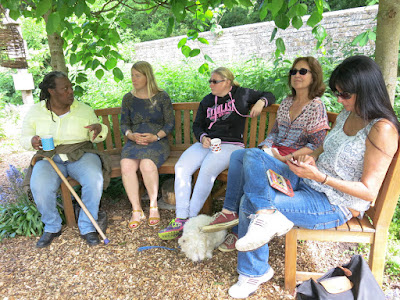
On 23 July 1856, around 60 boys from the Bath Workhouse, led by their schoolmaster Mr William Winkworth, completed a 16 mile walk from the Workhouse in Odd Down around the northern fringes of Bath. Sons of the city's poor, orphans, or whose parents were also Workhouse residents, through the summer of 2017 we will be retracing their steps. The walks have been devised by Richard White and writer/historian John Payne. The walks are free and in retracing this epic walk we invite walkers on fo [...]

Karlu Karlu: photographing landscapes
On the return trip once we had linked up to the Stuart Highway via the Buntine and Buchanan Highways we moved quickly south trying to make up for extra time in taking the northern route from Lajamanu. Our aim was get beyond Tennant Creek so that we could camp overnight in our swags at Karlu […]


Harnessing Our Power
The theme of the white horse began for me as a small child and the haunting but compelling tune of ‘White Horses‘ (from the old BBC children’s programme, sung by Jackie Lee) that I played over and over again on my parent’s record player. I didn’t understand the fascination, nor did I ever want to […]



Arctic log: Wednesday 12th October, Smeerenburg – Walrus, wonder and whaling (with added bits)
Wednesday 12.10.2016 Smeerenburg 79°43,7´N, 011°00.5´E, 2°C8m/s, wind picking up. Sunrise 10:02 – Sunset 17:23. I wake early and peer out of my porthole; still dark, there is now 22 minutes less daylight. I can just make out coastline and mountains. It’s raining; depressing, it shouldn’t be. What is happening to our climate? We move a short distance closer to the island of Smeerenburg, and there’s the usual scramble for equipment and to board the zodiac for the trip from ship to shore. The sky clear slightly as we leave the ship, light breaks through the clouds.Landing on the beach I gaze back to the far shore and dark mountains on the far side of the bay; it’s just wondrous, as though a stage has been set for me. In the gloom mist is gathering, hovering, moving slowly, and then it seems to be flowing upwards over the dark mountain peaks that poke through. Above an ethereal light is coming from somewhere out of the dark clouds so that the glaciers gleam, turning turquoise as they reach the sea. It looks so ridiculously magical, so unbelievably beautiful I feel I’m in a fairy tale world. Turning up the beach we find the walruses, lots of them, lying lazily in large companionable heaps, lolling, shifting, shuffling, rolling, an occasional flipper waving in the air, long white tusks appearing as a head raises to survey us, an occasional snort grunt and fart - they smell. A bit like huge slugs as wrinkled brown and pink skin rippling they haul their colossal bodies along the pale yellow sand. A young walrus swims with its parents, playfully sinking, surfacing, splashing, pausing to peer at this strange group who cluster on the beach and move as one edging closer to the Walrus mound, our cameras capturing their every move. (A point of information: the Walrus’s scientific name is Odobenus rosmarus which in Latin means tooth-walking seahorse).My feet are wet and I’m cold, and there are only so many photographs to be taken of a walrus; seeing them in the flesh is what counts, and they are pretty amazing to watch, but even this has its limits. Eventually we are able to tour around the remains of Smeerenburg - ´Blubbertown’ - an old 17th Century Dutch whaling station. First occupied by the Dutch in 1614, in its heyday (1630s) Smeerenburg was made up of 16–17 buildings. A board commemorates the site with a map showing the location of buildings and ovens. Having be warned to tread carefully and keep off the tundra (again!) we are allowed to wander carefully around the old ovens. Blackened lumps mark the remains of blubber ovens - rock fused with sand, gravel, and whale oil boiled together to make “blubber cement”, and where cooking vessels to render oil from the fat once stood. Remains of blubber ovensFlensing. Facsimile of a woodcut in the Cosmograhie Universelle ofThevet Folio, Paris 1574Blubber cement - It has a texture resembling asphalt. During this time there were as many as 200 men working ashore, 'flensing' whales (stripping the blubber), the blubber was then cut into small pieces, put into casks and boiled until it became oil. Scattered on the beach a mass of wood lies abandoned, amongst them the bleached white bones left from whales killed and dismembered on the beach; I ponder how old they must be. Surfaces scoured by wind and snow, lichen is beginning to take over, the bones look almost sculptural - shades of Barbara Hepworth and Henry Moore. A barren windswept island, swept by wild sea and storm, it must have been a pretty awful place to be amid the stench of death and boiling oil. On the ground lie patches of bright green and orange mosses, presumably fertilized by the ashes of slaughtered whales. By the second half of the century Smeerenberg was mostly abandoned since they had exhausted the supply of whales. The whale population never recovered. There are almost none left in the waters around Svalbard. Somewhere out here are the graves of over 100 men who lost their lives during the 17th and 18th century… but then I think of all the whales they killed. In the book The Solitude of Thomas Cave by Georgina Harding I find this quote:Extract from The Solitude of Thomas Cave, by Georgina HardingI look around me and imagine the horror of it all, but the surrounding mountains are a complete contrast to the slaughter and chaos that this beach must have endured. In the same book I find a quote echoing what I'm now seeing Across on the shore I can see the usual photographers at work. Despite its dark history it's a place to capture. I make a few quick drawings looking up at the misty blue blur of dark mountains and snow; the sky has that end-of-day pink.Standing awaiting the zodiacs a small Arctic fox appears trotting down to the beach. I watch from the Zodiac as it suddenly jumps into the mass of Walrus and disappears. In the afternoon I stay on board while others go on a trek up to the top of a glacier; I’m so tempted to join them but my clothes and boots are still wet from the morning, instead I spend some time trying to make colours that I see in the landscape. Grinding the water-colour pigments together that I’ve brought with me, mixing in sea water collected by lowering a bucket over the side of the boat and hoisting it up. This is a project I planned before I left the UK, and I still haven’t actually done anything about until now, so I need to get on with it while I have the opportunity and the deck is pretty much deserted. I spend half the time staring at the sea and glacier, trying to decide what exactly are those colours out there. Once I've mixed a batch I ask for them to be put in the freezer to be used at a later date… -->The Antigua moves off in cloud. We travel slowly through a pale green/grey icy sea, snow covering, ice scattering, sea slowly swelling as if breathing. Ellis O’Connor joins me on deck and we’re both drawing again as land and ice slips by. Marvelling at it allCan’t stop now - white that isn’t white, white that is many whites, soft black, dissolving merging melting dripping. I gather snow and push it into charcoal and pastel across the paper. Cold fingers. Visibility disappearing in freezing ice and snow that whips across the deck. These are some of the most perfect moments.Evening, we anchor in Fuglefjorden, 79°45,3´N, 011°31.5´E. Out on deck in the dark I listen to ice scrapping along the side of the boat, to ice cracking releasing its age-old air.Addendum: In January 2017 I travel to Amsterdam and wandering around the Rijksmuseum come across a painting of Smeerenberg The Whale-Oil Refinery near the Village of Smeerenburg (1639) by Cornelis de Man. The Whale-Oil Refinery near the Village of Smeerenburg (1639) by Cornelis de Man, Rijksmuseum, AmsterdamClearly from the look of it De Man didn’t actually ever visit the whaling station, painting it from the comfort of his studio at home, and apparently basing it on a Danish painting of a Svalbard whaling station and other images. I also discover in a nearby case beautiful knitted hats that were removed from excavated graves on Smeerenberg. I suppose due to the freezing conditions so far north, much of the clothing was very well-preserved. As the Rijksmuseum caption notes the men were bundled up so tightly against the cold that they would have only “recognized by the colours and patterns of their caps". As in Shetland fishermen wore distinctive jumper patterns knitted for each family members, I suppose here too, men working in Smeerenburg when pulled from the sea would also be identifiable by the pattern and colour of each hat. The original dyed rich colours of the thick caps have long since faded which have taken up the uniform brown colour of the soil they were buried in, but their original patterns with strips and varying shapes are still visible. They are wonderful pieces to pause by and wonder about who wore them and who knitted them.
•