Search
My feed

Curated News

Collection · 1058 items

Related

Curated news

Berkshire Camino: Walking at the Speed of Curiosity | Sponsored | Outdoors | Hudson Valley | Chronogram Magazine

The Pittsfield-based walking tour company blends the mindful and narrative traditions of the Spanish Camino de Santiago with quintessential Berkshires sights Source: Berkshire Camino: Walking at the Speed of Curiosity | Sponsored | Outdoors | Hudson Valley | Chronogram Magazine

Curated news

Walking as Resistance

A series of walking tours in Manchester show how neoliberal urban space systematically excludes anyone without money – and some unexpected ways to fight back against it. Source: Walking as Resistance

Curated news

How Do We Embody Natural Spaces?

Nicola López and Paula Wilson’s exhibition Becoming Land considers anthropocentric relationships with New Mexico’s desert landscapes. Source: How Do We Embody Natural Spaces?

Curated news

A walk around Constable Country – Country Life

Fiona Reynolds takes a stroll through a landscape which leaves her ‘inspired anew’. Source: A walk around Constable Country – Country Life

What Is a Soundwalk? – Soundfly

Spring has sprung! Get outside and experience your environment through sound with our guide to soundwalks.

Source: What Is a Soundwalk? – Soundfly
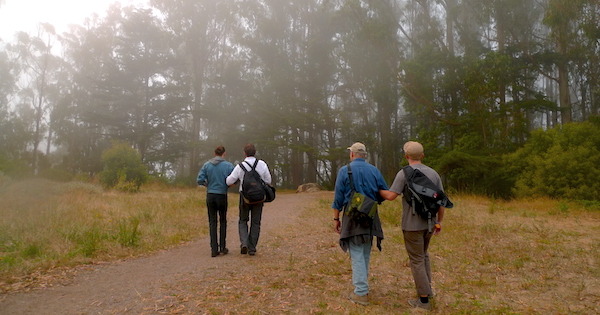
Submitted by: Babak Fakhamzadeh

pedestrian acts

By de Certeau: In “Walking in the City”, de Certeau conceives pedestrianism as a practice that is performed in the public space, whose architecture and behavioural habits substantially determine the way we walk. For de Certeau, the spatial order “organises an ensemble of possibilities (e.g. by a place in which one can move) and interdictions (e.g. by a wall that prevents one from going further)” and the walker “actualises some of these possibilities” by performing within its rules and limitations. “In that way,” says de Certeau, “he makes them exist as well as emerge.” Thus, pedestrians, as they walk conforming to the possibilities that are brought about by the spatial order of the city, constantly repeat and re-produce that spatial order, in a way ensuring its continuity. But, a pedestrian could also invent other possibilities. According to de Certeau, “the crossing, drifting away, or improvisation of walking privilege, transform or abandon spatial elements.” Hence, the pedestrians could, to a certain extent, elude the discipline of the spatial order of the city. Instead of repeating and re-producing the possibilities that are allowed, they can deviate, digress, drift away, depart, contravene, disrupt, subvert, or resist them. These acts, as he calls them, are pedestrian acts.

Problem?

Encountered a problem? Report it to let us know.

  • Include the page on which you encountered the problem.
  • Describe what happened.
  • Describe what you expected to happen.
Follow us