


Month: January 2017


walking, driving, eatingThis iPhone study was made just after…
walking, driving, eatingThis iPhone study was made just after the UK referendum. Shocked and angry at the result, I went walking along the seafront processing, transforming and recording the sounds on my iPhone. I caught a lift back, this time filming ...


Arctic Blog: Friday 7th October – ‘Værfast’ (Ymerbukta)
--> Friday 7/10/2016 2°C, Ymerbukta. 20m/s; Sunrise 09:21 – Sunset 18:06. Sea state – moderate; wind speed 7-8, gusting wind, speeds of up to 20 knots predicted. Grey-green sea, small waves break the surface.A hint of spindrift. Mist hovering, mountain shapes disappearing re-appearing. We are moving yet going nowhere. Last night the boat was moved closer to the entrance of the fjord, but despite two anchors we've been pulled half way back to where we originally moored on the northern side of the fjord. In the morning we reach a speed of 0.5 knots despite two anchors and 270m of chain out.The wind howls and gusts; a lull before it starts again. This isn’t a full blown-storm, force 7 is not so much - a moderate gale - but for this sailboat it is and we can't venture out into open sea, can’t leave the safety of the fjord, we are ´værfast´ so we stay put. We anchor. Some of the hardier amongst us jump into the sea from the boat with ropes tied around their waists. Not for me, therein lies madness!A small break in an otherwise grey overcast featureless sky. I make out dark shapes of mountains, no detail. It clears a little; snow on peaks, a few tiny buildings - trapper huts - on the shoreline. Waves racing towards land, white foam breaking, swirling, twisting. Colours change. Close to land there’s a strip of brown sea, on the far side of the boat the sea is a pale blue. The glacier reappears in front of us. Later, an apricot glow in the sky over the glacier, the sea looks much greener. On deck I make four paintings, well they make themselves as paint is blown across the paper by wind, washed by rain. ink, charcoal and pastel washed with rainpastel and charcoal and rain waterink, pastel and raincharcoal and pastel with rain waterEarly evening the sea becomes brown; a heavy sky, cloud and mist moving rapidly over the mountains. Every so often a loud gust of wind sweeps across the sea sending large waves racing shore-wards. The air is full of sound – anything that’s loose is moving, banging, rattling. Click on link below to see short film I've posted on Vimeo:https://vimeo.com/201751970?utm_source=email&utm_medium=vimeo-cliptranscode-201504&utm_campaign=29220In fading light I am drawing composites records of our movements. Very small drawings in a cut-down sketchbook. I start to worry I might run out of paper.Early evening we travel back to the southern shore, and anchor. A few hours later it’s clear that a single anchor is not holding us, a 2nd anchor goes down; we are still stuck in the fjord Maybe we will escape tomorrow. The northern lights put in a brief appearance.
 •



Let’s Take a Walk #36 The Women’s March in Washington
Getting ready to go to The Women's March in Washington. I will be walking for Equality and Respect for all; more specifically The Right for women to choose The Right to Love whomever one choose/The Sexual Orientation Right and for Climate Change Positi...


Arctic Blog: Wednesday 5th October 2016 Tunabreen
--> Wednesday 5/10/2016 Tunabreen 4°C, 2m/s Sunrise 09:05 – Sunset 18:23The Antigua remains anchored in front of the glacier. The day is overcast and raining which makes for dramatic cloud, drifting mist hanging in the mountains, the sea brown against a mass of luminous chunks of blue and white ice floating on its surface. The Belugas reappear, five white backs breaking the surface in unison. Last night I was sure we were moving since the boat was swaying so much. All that thudding and scrapping and shifting can now be attributed to glacial calving creating swell that rocked the boat. Most people go on the shore, a few remain inside writing or working on their computers. I remain on deck and try to paint – not very successfully, but later I lean over the side of the boat and hoist up seawater in a bucket and add it to pastels and charcoal, and the drawings start to work. Tunabreen - glacier from the Antigua charcoal and graphite on paperusing charcoal and sea waterusing ink, pastels and sea waterApart from the crew working or loitering on deck for a quick smoke I’m pretty much on my own. It’s peaceful; every so often there is a glacial calving, and we all stop and look towards the sound. I can never get to photograph one of these happening - you just never know when and where... but the sound is always startling and disturbing. According to Wikipedia glacier carving is a form of ice ablation or ice disruption and caused by the glacier expanding, which causes the sudden release and breaking away of a mass of ice from a glacier. The ice that breaks away can be classified as an iceberg, but may also be a growler, bergy bit, or a crevasse wall breakaway. I guess this depends on where it happens. Everyone piles back onto the boat – lunchtime. Later Ellis joins me on deck and we work side by side on the only table on deck, and we both marvel at the landscape and feel overwhelmed and wonder what on earth to do with it all. Ellis O'Connor and Janette Kerr - drawing on deck (pic by Spike)charcoal and chalk and a bit of seawaterwatercolour, chalks and seawaterwatercolour, chalks and seawaterWind increasing, the boat swings and shifting, the view changing so my drawings become combinations of different vistas. I draw fast - even more so now we are moving to another location. Early afternoon - anchor up, there are strong southerly winds. Three hours later we arrive at Gipsvika, 78°26,2´N, 016°25,9´E. The snow has gone, the mountains dark, softened by hanging mist.On shore at Gipshukodden, our rifle-toting lookouts form their usual triangle around us marking the area we are allowed to inhabit. As we arrived in front of the glacier three reindeer grazing on the hill make a quick exit. On the beach I walk to the highest place I’m allowed to go, sit and make drawings. Cold fingers.Around me others are occupied in their own tasks; a few draw, the poet and writers slowly pacing and pausing; sound artists donning headphones listen, photographers peer through cameras, tripods spread on ice and even in the sea, others just sit and look. We gather on the shore in the gloom, awaiting the arrival of the zodiacs to transport us back to the Antigua. Photos It definitely feels colder – but probably because I’ve been sitting for so long on the ground drawing. A few hardy folk stay to skinny-dip; I’m tempted but I’m not that mad! They don’t stay in very long. It’s been a busy day, anchor up, we sail out of Isfjorden (which apparently is the largest fjord system in Svalbard), and travel north through the night. Night view - just before we raise anchorOut on deck I can see the far shore and lights of Longyearbyen again. Strange to see them; I feel such a long way from civilization, yet it’s only been two days. I love being out there in the dark. A sky full of stars; the northern lights are out again (not as strong as the previous time).
• 
Arctic Blog – Oct 2nd/3rd/4th: Embarkation and my first sight of a glacier
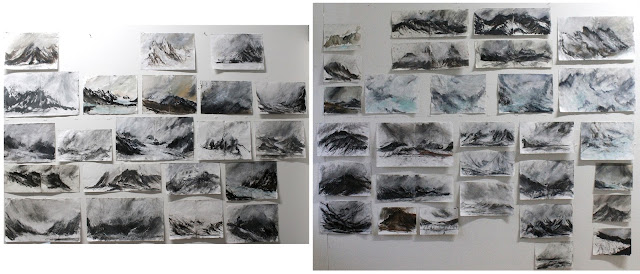
It has taken me a while to get my diary notes written up and to sort out the hundreds of photographs I have taken while traveling. Most of my drawings and water-colours are now up on the wall in my studio (well those not in sketch books) and I'm struggling with how to make images from it all. A wall of Arctic sketchesIt's so different to painting seas. Since returning home I've been a bit busy ...had a solo show at Cadogan Contemporary in London, driven up Shetland to give a paper and exhibit a few of the drawings made in Svalbard at the Relate North symposium focusing on the Arctic, all of which fortuitously took place at the Museum in Lerwick (and at which I met some lovely people from Finland), I've flown back to Norway for a few days; then there was Christmas and New Year so off back to Shetland just in time for the wildness of Storm Barbara and Storm Connor to hit us, and I've just been to Amsterdam.... In between all this I've been transcribing all my Arctic trip notes on my laptop, as well as writing an application for another project, and trying to get to the studio and make some work. So please forgive the lateness of my Arctic Blog.Just to recap.......Prior to my expedition to Svalbard I spent a year researching the Arctic and concepts relating to ‘northerness’….. Book cover found in a Svalbard art gallery An inherent spirituality associated with the north can be traced back to the Greeks, whose paradise-like ultima Thule was said to exist at the back of the north wind. In medieval geographies ultima Thule represents any distant place located beyond the ‘borders of the known world - a bleak, inhospitable terrain of ice, rock, and volcanoes…. between physical and metaphysical realms’. In Tove Janssons’ Moomintroll books the Groke represents the negative force of northern winter – an avator of the frost giants of old Northern mythology, the enemy of the sociable summer happiness. Reading accounts of 18th and 19thC expeditions, attempts to reach the Pole - on foot, with dogs and sledges, on skis, by airship, by hot air balloon, by plane - failed expeditions to find the northwest passage with ships stuck in ice for years, slowly crushed and then abandoned, I was struck by how Arctic history is a legacy of desires - to discover riches, a stage for personal quests and heroism, the need for national pride. Descriptions of hardships suffered, deaths, attitudes towards the Inuit, the constant need to name and claim places, were both fascinating and depressing. Fridtjof Nansen, who successfully traversed the north-west passage in his polar ship Fram, wrote in 1911 “nowhere else have we won our way more slowly, nowhere else has every new step caused so much trouble, so many privations, and sufferings, and certainly nowhere have the resulting discoveries promised fewer material advantages”. There is an old ambiguity about going to such places to find or lose oneself, but perhaps it is more that the north is a place that intensifies experiences rather than providing answers or transformations. We have an idea of the far north as a limitless, an almost incomprehensible metaphysical space - of north as moving “always out of reach,” leading “always to a further north, to an elsewhere.” So back to Longyearbyen.I'm told that there was never an indigenous population in Svalbard. Before Mr Longyearbyen established it as a coalmining town in early 20thC, this was a place where trappers arrived and left bearing furs, and whalers came to plunder and ultimately exhaust its waters. . Mist drifting over the tops of the dark mountains that close in around the town At the top of town the road stops and a track leads out and into a wilderness of snow and receding mountains – and where we are strictly instructed not to go unless accompanied by an armed guide – there are bears out there. But it looks so tempting…Going the other way, the road follows the sea to the airport, passing the soon-to-be closed modern coalmine with heaps of prime coal still lying beside the road, and up above the town to the Svalbard Global Seed Vault. This wedge of steel cuts deep into the mountain, into the permafrost so temperature is constant. Inside is the world's largest collection of crop diversity seeds; a fail-safe bank built to stand natural or man-made disasters. If you want to take a look inside follow this link: https://www.croptrust.org/our-work/svalbard-global-seed-vault/interactive-visit/ Standing on one bleak shore with the late afternoon light already starting to fade, geese and sea gulls fly before me as I walk along the edge of the sea gazing across at the mass of monochromatic snow-covered mountain range ringing the town. There’s a film shoot session in progress, a band hovers around a campfire. The backdrop is pretty stupendous; let’s hope their music is. Monday 3/10/2016 78°13.7´N, 015°36.3´E Sunrise 08:50 - Sunset 18:39; O°C, wind 12m/secEmbarkation day Looking out of the hostel in the morning and the world looks wonderful, dark muddy land transformed by a covering of powdery snow.I wander up the road and watch snow making its way across the mountains until the view is obliterated. Time to return to the hostel to catch the bus to the harbour and find the Antigua.Tumbling from the bus dragging our luggage through the snow, we gather in front of the Antigua – home for the next two weeks. embarkationIt’s all ropes and sails and masts. Crossing the gangplank snow falls faster and faster, obliterating the far shore. Leaving suitcases and bags piled on deck disappearing beneath a covering of snow we investigate our cabins. As I anticipated there is not much room but I am still shocked at the lack of space – two bunks and one tiny porthole – no room to swing a cat, let alone store wet paintings, and it’s stiflingly hot. Hey-ho, most of my time will be spent on deck; maybe I could sleep there as well. The ship sets out to sea, and most of us are out on deck following what we can still see of the coastline through the swirling snow. View from boat as we leave LongyearbyenThe plan is to sail to Ymerbukta. It stops snowing during the afternoon and the light is spectacular against the backdrop of jagged mountains - white against white, traces of luminous blue now pink slowly fading as we head out into a sea that is becoming increasingly rough. Glad I’ve taken my seasick pills. Sea birds follow swooping between wave and sky. Standing on deck has its rewards as a group of white-beaked dolphins join us, coursing through the waves, dipping and diving in front of the boat. Not usual visitors to this area, they’re an indication of warming seas since they must only be here because there’s food about. A less than enthusiastic response by some greets the sound of the ship’s dinner bell, the heavy sea having already taken its toll. A couple of bowls of creamy coconut pudding seems to calm stomachs, and We help put the sails up and once sails are raised it feels less turbulent. Later, out on deck, I stand in the dark watching white sails buffeting in the wind. The pole star is almost directly above us. I try to remember where stars are when I’m back home; there’s the Plough and Orion’s Belt, but then I’m lost in an increasingly clearing star-filled sky. We are rewarded by a display of northern lights, long tendrils of white light snake downwards, a green glow pulsating on the horizon. All this and only our first night at sea. I wander around the deck pressing my ear against the ropes. They make interesting sounds, vibrating against the tension of wind-filled sails, a bit like listening to dub beat. Mid evening, the boat makes a 180° turn, changing course and sailing north -east. It’s been a rough start. Later we anchor at Bjonahamna 78°23,6'N, 016°51,6'E. Tuesday 4/10/2016 Bjonahamna -2°C, 7m/s wind, Sunrise 08:58 – Sunset 18:31I stand out on the deck watching the morning light slowly brightening and playing across the mountains - it's a pretty overwhelming landscape. A morning landing - our first stop (and the day I should have taken the kite). We stand on deck waiting, life jackets on, a briefing on how to get into and behave in a Zodiac. I can’t feel any wind, the sea’s completely calm, so leaving my kite on deck and clutching snow-boots, rucksack full of paper, charcoal, pastels, camera slung round my neck (have I remembered everything?) I climb into a Zodiac and we head for shore. Landing on a beach, a big bank of white pristine snow deep enough to sink into up to my thighs confronts us. I clamber onto a flat plateau and walk around slightly dazed; shining sun, blue sky, silence, white clad mountains with ridges of dark rock surround us. The group fans out, I feel in shock, scale and distance confound the eye, completely dwarfed by the land. Walls of rock towers above me rising up into the sky like castle battlements. Close up it is as though I'm looking at an abstract painting. Wall of rock and snowWhere to start? I walk to the end of the spit of land, sit in the snow and draw, concentrating on dark areas of the mountains. The light is strange, sun hanging low in the sky - almost as though it's late afternoon and not morning. I'm having difficulty knowing what time it is since not only are we now an hour forward of UK time, we are also another hour forward - 'boat time' - so we can make use of as much daylight as there is, and there will be less each day.snow ridge between land and seaThen I suddenly realise that there’s a wind – maybe strong enough to fly the kite. And this large flat area would be perfect… But the kite’s on the boat and frustratingly there’s now not time to get taken back to collect it. I reason there will be other occasions, so back to drawing. I rub snow into the paper, blending pastel and charcoal; still wet when I walk back along the shoreline and clamber into the Zodiac carefully balancing bits of paper. charcoal, chalk and snow on paperLater in my notes I write ‘ ‘Still can’t work out how to draw this landscape..’ . What I am thinking? It’s only the first day! Early afternoon, anchor up, we sail from Bjonahamna arriving at Tunabreen 78°23,1'N, 017°23,7'E and there’s my first glacier, a vast mass of turquoise ice against burnt umber rocks, luminous pale blue sea reflecting a bright blue sky and dark mountains. The Antigua moves slowly into the bay, nosing its way through through a sea of floating glacial ice; this is unchartered water - where glacier used to be. The second mate climbs out along the bow to the front, leaning out to radio back to Bridge our progress as we approach the shore. Ahead in shallow water a small pod of white Beluga whales silently surfaces and dips, gently blowing water as they pass. We stand quietly watching their progress. We stop directly in front of the glacier. It is so blue I can't quite believe it, so massive. Tunabreen A low rumbling seems to come from all around me, then a deep loud cracking sound and suddenly hugh lumps of ice detach themselves and fall, sliding vertically almost in slow motion, crashing into the sea; the glacier is calving. It is a terrible yet fascinating sight. Silence, a strange calm, and then the sea responds, wave after wave roll onto the shore, the boat rocks. This is an event that is to be repeated over and over during our stay.We are going to land on a newly revealed island – now named ´Jægerøya´ - land once connected to glacier Tunabreen before it retreated. I know that no continents are static - seismic/tectonic activity see to that - but these movements mostly take eons. Yet the far north moves around all the time, visibly, every time the ice grows and melts – you can see it moving - which means it exists beyond accurate cartography. Travelling to shore is delayed while the glacier calves again and we wait for the water to calm. Finally we are on land, rock and ice beneath our feet; so close to the glacier that I can’t speak. A vast cliff of ice rising above me, terrifying and magnificent. I walk, breathing in cold clear air, sound muted, compressed. We move slowly trying to get our bearings, small smudges against a vast monochromatic backdrop It’s weird finally being so close to a glacier; I have imagined them but had no real idea what they actually looked like and what it would feel like to be standing in front of one. It’s emotional, and when, inexplicably since there shouldn’t be a signal out here, my mobile phone rings and it’s my partner, I cry and try to describe to him what I am looking at; the vast cliff of ice rising up in front of me, not clean nor smooth and white as I’d imagined, like a sort of ice rink to slip and slide and ride on. Instead the surface is rugged, pitted with peaks and troughs, marbled with veins of browns and blues running through the ice. Thick ice radiates an ethereal blue color difficult to describe, hovering between turquoises with hints of cobalt. Blue because glacial ice becomes so dense over years of compression, squeezing, forcing out the tiny air pockets between crystals. Extremely dense ice absorbs a small amount of red light, leaving a bluish tint in reflected light. So blue is a sign of old age - ice formed thousands of years ago. I crouch down and look at the bottom of the ice, remnants from the last Ice Age, and I think about the hundreds, even thousands of years locked away inside, suspended in tiny air bubbles. I think about how many years that snow has fallen, compressing into this enormous thick ice mass that is slowly flowing down the mountain valley, the sheer weight pulling with it the debris of earth and rock with it, sliding relentlessly to the sea. Walking around ice lying on the shore, I hear the popping of air bubbles releasing age-old air into the atmosphere; it’s as though it’s breathing out. Peering into clear white ice, wonderful patterns of masses of tiny air bubbles lie trapped inside. frozen airEventually I sit on the ground and try to recreate colours I see, mixing ice and snow with watercolour. So much to look at perhaps it’s still too soon to even try paint. Blue and brown watercolour, bits of ice float together moving across the page. Too ephemeral to carry back to the boat, I photograph the images allowing paint to merge, flow across the paper and disappear. ice and watercoloursice, watercolours and earthdissolving Usually alone in my studio or out on a coastline drawing and painting, it feels strange working with other artists around me but also companionable; everyone’s involved in doing their own thing, alone in their internal worlds and at the same time there’s an unacknowledged shared intention, we’re all responding to the same place. Later we trek around the glacier walking close to the vast mass of ice glistening around us, whites, turquoises, streaked dark black and brown like marble. A strange landscape. The Antigua awaiting our return Then it's back to the shore to await the zodiacs and return to the ship
• 
PhD Research Paper #4: A diversity of words and images – topographers and antiquarians, artists and writers at Llanthony and the Vale of Ewyas
From time to time I will post 'bite size' chunks of the material I am preparing for my PhD thesis: works in progress, but content which I feel may be of interest to a wider audience. All will be very much draft versions, not necessarily - probably not ...


The Genhe Tour: a journey to the coldest place in China
Out of the blue I received an invitation to participate in the Burnt By Snow festival, which was taking place over the soon approaching Christmas weekend. It was not entirely clear to me where this was happening but, since I didn't have any o...

