Search
My feed
Vermont Ave, Los Angeles, CA, USA

Curated News

Collection · 1058 items

Related

Curated news

Take a Walking Tour of “America’s Oldest… Celtic City” St. Augustine ! – Folio 2.0 / EU Jacksonville

    by Albert Syeles, President of Romanza  Every March “Spanish” St. Augustine, Florida, USA, ce Source: Take a Walking Tour of “America’s Oldest… Celtic City” St. Augustine ! – Folio 2.0 / EU Jacksonville

Curated news

Moving message for peace: Murals, art show support for Ukraine around the globe

Artists around the globe show support and solidarity with Ukrainians amid Russian military attacks on the country. Source: Moving message for peace: Murals, art show support for Ukraine around the globe

Curated news

Topographies of Fragility – Photographs and text by Ingrid Weyland | LensCulture

This Argentinian artist doubles up crumpled and pristine photographs of the same places to create evocative landscapes expressing the fragility of the natural environment Source: Topographies of Fragility – Photographs and text by Ingrid Weyland | LensCulture

Curated news

Walking Mexico City in the footsteps of Luis Buñuel

The ever-changing city. Source: Walking Mexico City in the footsteps of Luis Buñuel

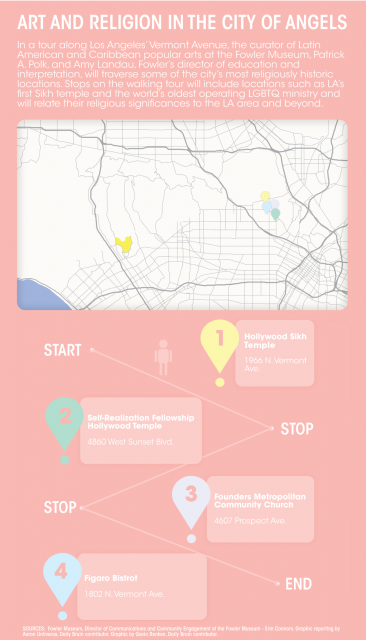
Fowler Museum’s walking tour aims to engage community with LA religious sphere – Daily Bruin

Take a stroll down Vermont Avenue and encounter the Church of Scientology, the first Sikh temple in Los Angeles and an LGBTQ ministry. In an effort to spread awareness about religion in Los Angeles, the Fowler Museum’s curator of Latin American and Caribbean popular arts Patrick A.

Source: Fowler Museum’s walking tour aims to engage community with LA religious sphere – Daily Bruin

Submitted by: Babak Fakhamzadeh

pedestrian acts

By de Certeau: In “Walking in the City”, de Certeau conceives pedestrianism as a practice that is performed in the public space, whose architecture and behavioural habits substantially determine the way we walk. For de Certeau, the spatial order “organises an ensemble of possibilities (e.g. by a place in which one can move) and interdictions (e.g. by a wall that prevents one from going further)” and the walker “actualises some of these possibilities” by performing within its rules and limitations. “In that way,” says de Certeau, “he makes them exist as well as emerge.” Thus, pedestrians, as they walk conforming to the possibilities that are brought about by the spatial order of the city, constantly repeat and re-produce that spatial order, in a way ensuring its continuity. But, a pedestrian could also invent other possibilities. According to de Certeau, “the crossing, drifting away, or improvisation of walking privilege, transform or abandon spatial elements.” Hence, the pedestrians could, to a certain extent, elude the discipline of the spatial order of the city. Instead of repeating and re-producing the possibilities that are allowed, they can deviate, digress, drift away, depart, contravene, disrupt, subvert, or resist them. These acts, as he calls them, are pedestrian acts.

Problem?

Encountered a problem? Report it to let us know.

  • Include the page on which you encountered the problem.
  • Describe what happened.
  • Describe what you expected to happen.
Follow us