Search
My feed
Olympic National Forest, Washington 98363, USA

Curated News

Collection · 1061 items

Related

Curated news

How does nature nurture the brain? | Max-Planck-Gesellschaft

After a 60-minute walk in nature, activity in brain regions involved in stress processing decreases. This is the finding of a recent study by the Lise Meitner Group for Environmental Neuroscience at the Max Planck Institute for Human Development, published in Molecular Psychiatry. Source: How does nature nurture the brain? | Max-Planck-Gesellschaft

Curated news

Walking for Art

The visual stutter of Mary Lum’s artwork invites us to enunciate the staccato repetitions of sounds we hear and see when we walk through the city. Source: Walking for Art

Curated news

How nature nurtures: Amygdala activity decreases as the result of a one-hour walk in nature | Molecular Psychiatry

Since living in cities is associated with an increased risk for mental disorders such as anxiety disorders, depression, and schizophrenia, it is essential to understand how exposure to urban and natural environments affects mental health and the brain. It has been shown that the amygdala is more activated during a stress task in urban compared

Curated news

London Podcast Festival • What’s On • Kings Place

The London Podcast Festival is back for it’s sixth year. Taking place live at Kings Place from the 8th – 19th SEPTEMBER, the UK’s home of podcasting, the festival will see some of the biggest and brightest names on the podcasting scene perform in front of a limited capacity, socially-distanced audience. All events will also

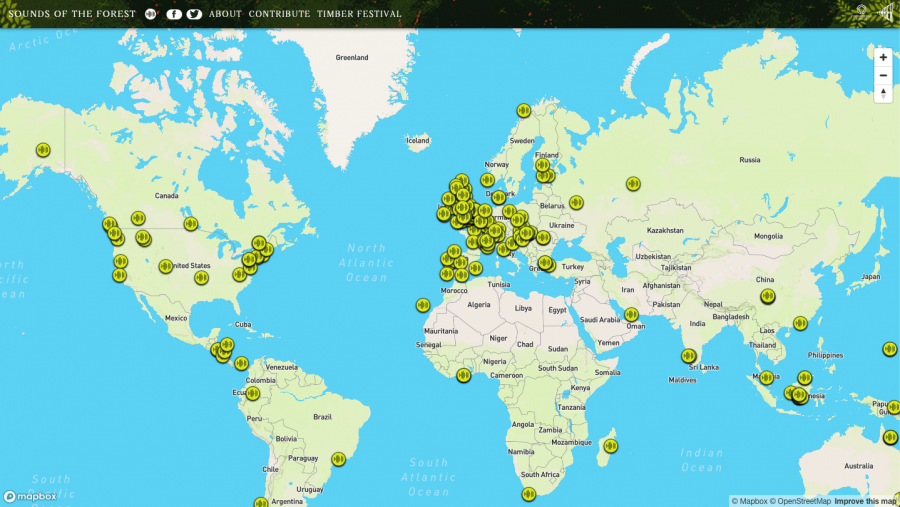
Sounds of the Forest: A Free Audio Archive Gathers the Sounds of Forests from All Over the World | Open Culture

Some of my fondest memories are of hiking the Olympic National Forest in Washington State and the forests of the Shenandoah Valley in Virginia, seeking the kind of silence one can only find in busy ecosystems full of birds, insects, woodland creatures, rustling leaves, etc.

Source: Sounds of the Forest: A Free Audio Archive Gathers the Sounds of Forests from All Over the World | Open Culture

Submitted by: Babak Fakhamzadeh

pedestrian acts

By de Certeau: In “Walking in the City”, de Certeau conceives pedestrianism as a practice that is performed in the public space, whose architecture and behavioural habits substantially determine the way we walk. For de Certeau, the spatial order “organises an ensemble of possibilities (e.g. by a place in which one can move) and interdictions (e.g. by a wall that prevents one from going further)” and the walker “actualises some of these possibilities” by performing within its rules and limitations. “In that way,” says de Certeau, “he makes them exist as well as emerge.” Thus, pedestrians, as they walk conforming to the possibilities that are brought about by the spatial order of the city, constantly repeat and re-produce that spatial order, in a way ensuring its continuity. But, a pedestrian could also invent other possibilities. According to de Certeau, “the crossing, drifting away, or improvisation of walking privilege, transform or abandon spatial elements.” Hence, the pedestrians could, to a certain extent, elude the discipline of the spatial order of the city. Instead of repeating and re-producing the possibilities that are allowed, they can deviate, digress, drift away, depart, contravene, disrupt, subvert, or resist them. These acts, as he calls them, are pedestrian acts.

Problem?

Encountered a problem? Report it to let us know.

  • Include the page on which you encountered the problem.
  • Describe what happened.
  • Describe what you expected to happen.
Follow us