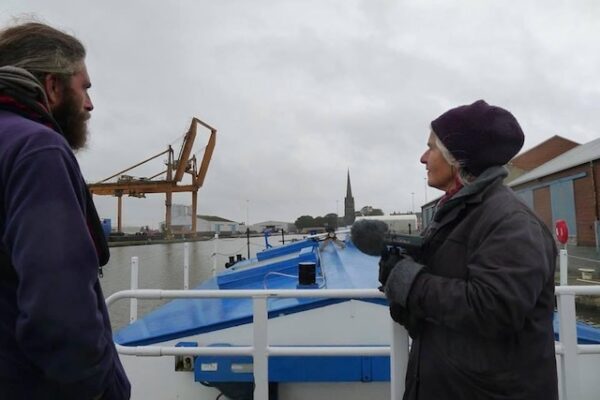
It might seem strange that a walk in itself can be a work of art. Yet there has long been a tradition of British artist walkers – or walking artists: Francis Alÿs, Richard Long, Hamish …
Source: Hastings Online Times – Sound walk with Mary Hooper
Splash Magazines Worldwide is your destination for in-depth culture coverage including theatre, opera, classical music, jazz, dance and the arts; travel and leisure reviews; restaurant reviews; lifestyle subjects; celebrity interviews; fashion advice; environmentally conscious living; gift-giving recommendations; pets; charity events; select book reviews; and useful product reviews.<meta name= Source: Walking in the Footsteps of Van
If you love stories and walking, you’ll find a lot of both at StoryFest 2023. The annual festival is back with a new format that lets you explore the Civic District through an outdoor storytelling experience called Story Walk. Source: StoryFest 2023 invites Singaporeans to walk and talk in the Civic District
It might seem strange that a walk in itself can be a work of art. Yet there has long been a tradition of British artist walkers – or walking artists: Francis Alÿs, Richard Long, Hamish …
Source: Hastings Online Times – Sound walk with Mary Hooper
pedestrian acts
By de Certeau: In “Walking in the City”, de Certeau conceives pedestrianism as a practice that is performed in the public space, whose architecture and behavioural habits substantially determine the way we walk. For de Certeau, the spatial order “organises an ensemble of possibilities (e.g. by a place in which one can move) and interdictions (e.g. by a wall that prevents one from going further)” and the walker “actualises some of these possibilities” by performing within its rules and limitations. “In that way,” says de Certeau, “he makes them exist as well as emerge.” Thus, pedestrians, as they walk conforming to the possibilities that are brought about by the spatial order of the city, constantly repeat and re-produce that spatial order, in a way ensuring its continuity. But, a pedestrian could also invent other possibilities. According to de Certeau, “the crossing, drifting away, or improvisation of walking privilege, transform or abandon spatial elements.” Hence, the pedestrians could, to a certain extent, elude the discipline of the spatial order of the city. Instead of repeating and re-producing the possibilities that are allowed, they can deviate, digress, drift away, depart, contravene, disrupt, subvert, or resist them. These acts, as he calls them, are pedestrian acts.
Encountered a problem? Report it to let us know.
You must be logged in to post a comment.