Search
My feed
Peace Bridge, Calgary, AB T2N 3C9, Canada

Curated News

Collection · 1063 items

Related

Curated news

Meryl Meisler’s ‘Street Walker’ is a Time Capsule of 1970s America — Colossal

Graflex Norita in hand, Meryl Meisler walked the streets of cultural epicenters in 1970’s America and boldly photographed transient moments of coincidence. Source: Meryl Meisler’s ‘Street Walker’ is a Time Capsule of 1970s America — Colossal

Curated news

Europe beats the US for walkable, livable cities, study shows | Environment | The Guardian

Cities such as Zurich and Dublin found to have key services accessible within 15 minutes for more than 95% of residents Source: Europe beats the US for walkable, livable cities, study shows | Environment | The Guardian

Curated news

Interview with Sylvie Marchand: Hospitality in Artistic Actions

Source: Interview with Sylvie Marchand: Hospitality in Artistic Actions

Curated news

The Internationalist Anti-Colonialism of the Situationists | The Brooklyn Rail

Despite its ethnic composition, the SI, as its name implies, was not only an international organization, but also never gave up its internationalism. Source: The Internationalist Anti-Colonialism of the Situationists | The Brooklyn Rail

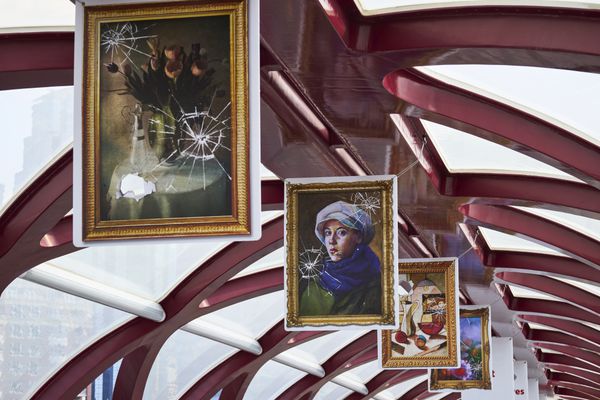
Calgary turns Peace Bridge into an art walk after iconic structure suffers more than $1-million in damage – The Globe and Mail

An art walk called the Vandalism Gallery created inside Calgary’s Peace Bridge is a campaign to teach the public about vandalism done to the bridge

Source: Calgary turns Peace Bridge into an art walk after iconic structure suffers more than $1-million in damage – The Globe and Mail

Submitted by: Babak Fakhamzadeh

pedestrian acts

By de Certeau: In “Walking in the City”, de Certeau conceives pedestrianism as a practice that is performed in the public space, whose architecture and behavioural habits substantially determine the way we walk. For de Certeau, the spatial order “organises an ensemble of possibilities (e.g. by a place in which one can move) and interdictions (e.g. by a wall that prevents one from going further)” and the walker “actualises some of these possibilities” by performing within its rules and limitations. “In that way,” says de Certeau, “he makes them exist as well as emerge.” Thus, pedestrians, as they walk conforming to the possibilities that are brought about by the spatial order of the city, constantly repeat and re-produce that spatial order, in a way ensuring its continuity. But, a pedestrian could also invent other possibilities. According to de Certeau, “the crossing, drifting away, or improvisation of walking privilege, transform or abandon spatial elements.” Hence, the pedestrians could, to a certain extent, elude the discipline of the spatial order of the city. Instead of repeating and re-producing the possibilities that are allowed, they can deviate, digress, drift away, depart, contravene, disrupt, subvert, or resist them. These acts, as he calls them, are pedestrian acts.

Problem?

Encountered a problem? Report it to let us know.

  • Include the page on which you encountered the problem.
  • Describe what happened.
  • Describe what you expected to happen.
Follow us