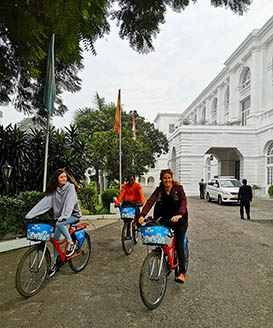
Discover the city of New Delhi on foot as you bookmark these heritage walks to the gems in the national capital.
Source: 5 best heritage walks in Delhi – Luxebook
Words and photos by Streets Dept Lead Contributor Eric Dale.______________________ This post is a free sample of our monthly “Local Tourist” column, a Patreon-exclusive series that recommends … Source: Local Tourist: How To Take Yourself On A Mile-long, Road-free Stroll Through University City – Streets Dept
Axel Pons, formerly a competitor in the Moto2 World Championship, changed up his lifestyle dramatically six years ago when he decided to travel the world barefoot. Son of the legendary Sito Pons, two-time MotoGP winner, Axel Source: Former Motorycle Racing Star Has Been Traveling the World Barefoot for Six Years
It’s a well trodden fact that running with other people is good for camaraderie, safety and our physical and mental wellbeing – but now it seems it’s fertile ground for dating Source: Health, happiness … and romance? How running could help you find love | Running | The Guardian
Discover the city of New Delhi on foot as you bookmark these heritage walks to the gems in the national capital.
Source: 5 best heritage walks in Delhi – Luxebook
pedestrian acts
By de Certeau: In “Walking in the City”, de Certeau conceives pedestrianism as a practice that is performed in the public space, whose architecture and behavioural habits substantially determine the way we walk. For de Certeau, the spatial order “organises an ensemble of possibilities (e.g. by a place in which one can move) and interdictions (e.g. by a wall that prevents one from going further)” and the walker “actualises some of these possibilities” by performing within its rules and limitations. “In that way,” says de Certeau, “he makes them exist as well as emerge.” Thus, pedestrians, as they walk conforming to the possibilities that are brought about by the spatial order of the city, constantly repeat and re-produce that spatial order, in a way ensuring its continuity. But, a pedestrian could also invent other possibilities. According to de Certeau, “the crossing, drifting away, or improvisation of walking privilege, transform or abandon spatial elements.” Hence, the pedestrians could, to a certain extent, elude the discipline of the spatial order of the city. Instead of repeating and re-producing the possibilities that are allowed, they can deviate, digress, drift away, depart, contravene, disrupt, subvert, or resist them. These acts, as he calls them, are pedestrian acts.
Encountered a problem? Report it to let us know.
You must be logged in to post a comment.