Search
My feed

From Arcadia to Arcades

From Arcadia to Arcades

Thread and Word present From Arcadia to the Arcades.

Sunday September 26th 1.30pm
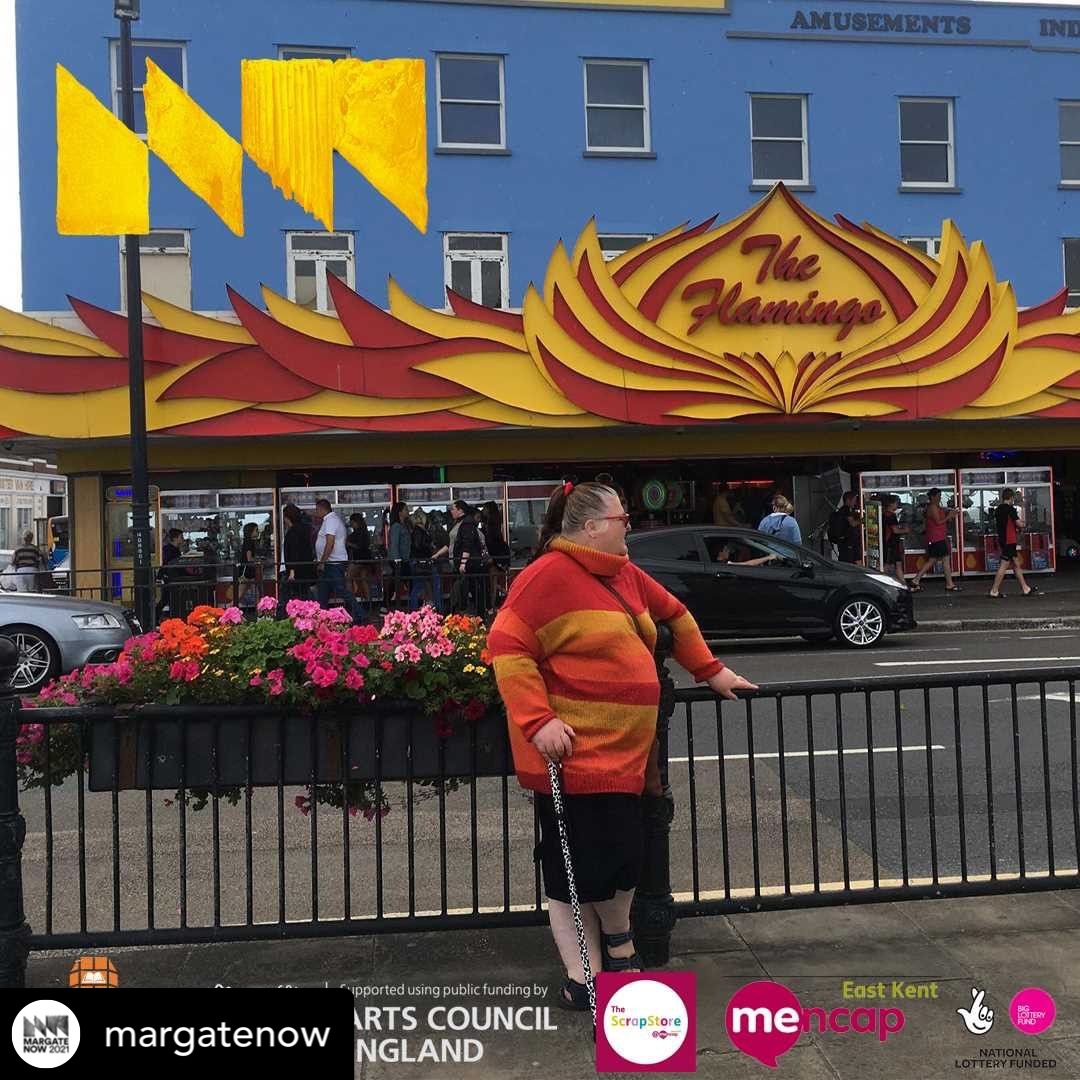
Thread and Word have created a unique set of 32 walking cards with prompts. Inspired by Tom Stoppard’s play Arcadia, the cards may make you consider the people and places around you in a new way.
These cards have been developed during our workshops with East Kent Mencap members.
We’ll chat our way from the Sunken Gardens in Westbrook to the Clocktower in Margate. Along the way we’ll look at the Nayland Rock’s history and talk about gardens, books, plays and botany. And, if you’ve seen Arcadia or know the Sunken Gardens, we may even talk about how they are linked!
Free to all. You can reserve a ticket at http://margatebookie.com just to make sure of your place.

Thread and Word present The Long Table

Sunday September 26th 3.30pm
The Margate School (The old Woollies, 31-33 High Street)
An invitation for all of you to join in with a presentation on A Refracted View. You’ll meet artists, academics, walkers and friends who’ve partnered with the local group Thread and Word since the Estuary Festival in June.
Pre-booking essential. Get your tickets at http://margatebookie.com. Free tea and biscuits for all participants!

About Thread and Word
In 2014 Bille Penfold (MRSS FRSA) formed Thread and Word to bring people together through a shared love of poetry and textiles. Based in Whitstable, but often in Margate, Billie uses digital media, sound and locative mapping to create unique walking events. Her friendly and fun events combine walking, weaving and storytelling.

This event has happened

2021-09-26 12:30
2021-09-26 12:30
2021-09-26 12:30

Hosted by: The Margate Bookie and Margate NOW2020
The Margate School, High Street, Margate, UK

gardens

Collection · 20 items

Margate

Collection · 10 items

Related

Walking piece

Mapping a Rhizomatic Wander

Enchanted Charms is a quipu map. Quipu translates as knot in Quechua. The anthropologist . Frank Solomon states that quipu cords are paths guiding the hands, eye and mind to the trans-temporal source of things. .

Elspeth Penfold
walkingevent

Summer Soundwalks 2019 – Part 4: “Walkie Talkie Dream Garden”

“Walkie Talkie Dream Garden”, by Dafna Naphtali (2018) Thursday, 26 Sep 2019, 6-8PM Meet just inside the gate to East River State Park at Kent and N. 8th Street For the fourth and final installment of Summer Soundwalks 2019 we head across the East River — but just barely — to the Williamsburg waterfront, for

Richard Rodkin
Sound walk

Sculpture trail in the gardens of Waddesdon Manor

The gardens at Waddesdon feature predominantly marble sculptures depicting human, animal, mythological, and allegorical figures that structure pathways and focal points within the landscape. These sculptures interact with natural processes like algae, lichen growth, and insect habitation, emphasizing themes of growth, decay, and the passage of time.

Victoria Jenner
Sound walk

Radio Walks – The Urban Gardener

An urban walk with hope of a greener future.

Jonathan Kempster
post

Eccentric outsider, colonialist, environmentalist avant la lettre

In Flora and the Baron, the team at Bowerbird Theatre tell the tale of Baron Ferdinand von Mueller, eccentric outsider, global scientific powerhouse and the Royal Botanic Gardens Victoria’s first director. That's in Melbourne. Or, rather, the baron tells the tale himself.

Karen Berger Davijos

pedestrian acts

By de Certeau: In “Walking in the City”, de Certeau conceives pedestrianism as a practice that is performed in the public space, whose architecture and behavioural habits substantially determine the way we walk. For de Certeau, the spatial order “organises an ensemble of possibilities (e.g. by a place in which one can move) and interdictions (e.g. by a wall that prevents one from going further)” and the walker “actualises some of these possibilities” by performing within its rules and limitations. “In that way,” says de Certeau, “he makes them exist as well as emerge.” Thus, pedestrians, as they walk conforming to the possibilities that are brought about by the spatial order of the city, constantly repeat and re-produce that spatial order, in a way ensuring its continuity. But, a pedestrian could also invent other possibilities. According to de Certeau, “the crossing, drifting away, or improvisation of walking privilege, transform or abandon spatial elements.” Hence, the pedestrians could, to a certain extent, elude the discipline of the spatial order of the city. Instead of repeating and re-producing the possibilities that are allowed, they can deviate, digress, drift away, depart, contravene, disrupt, subvert, or resist them. These acts, as he calls them, are pedestrian acts.

Problem?

Encountered a problem? Report it to let us know.

  • Include the page on which you encountered the problem.
  • Describe what happened.
  • Describe what you expected to happen.
Follow us