Search
My feed

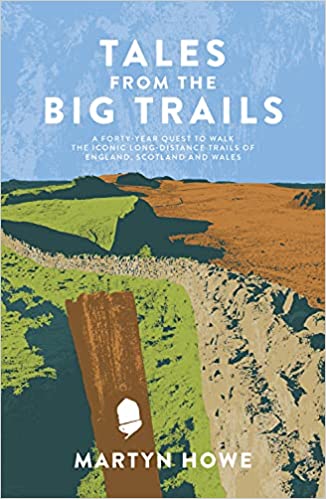
Tales from the Big Trails

51E9P2oZqHL._SX324_BO1,204,203,200_
Sub-collection

Long Distance Trails

Sub-collection · 4 items
Sub-collection

long distance walking

Sub-collection · 32 items

Related

book

Lure of the Lost

A Contemporary Pilgrimage: Walking from Huntly to Venice. In 2015, Deveron Projects commissed artist Anthony Schrag to undertake a long-distance walk from our home town of Huntly in the North East of Scotland to the Venice Biennale. The Venice Biennale is widely recognised as the largest and most significant art festival in the world, and

Anthony Schrag
book

The Farthest Shore

The Farthest Shore is the story of Alex’s solo trek along the remote Cape Wrath Trail. As he journeyed through a vanishing winter, Alex found answers to his questions, learnt the nature of true silence, and discovered frightening evidence of the threats faced by Scotland’s wild mountain landscape.

Alex Roddie
walkingevent

Daniella Turbin SP010986 I Walk and Chalk

The New Art Gallery Walsall Daniella Turbin SP010986 Wolverhampton based artist Daniella Turbin took up the pursuit of long distance walking out of necessity when she was living in a remote area of Cumbria. Since returning to the West Midlands in 2019 Daniella has been determined to walk every square kilometre of the UK Ordnance

Daniella Turbin
book

Seven Days

Seven Days is a story of adventure and spirituality as father and son travel the 'Rue du Bonjour' across the pilgrim route of the high Pyrenees. 

Nathan Munday
post

Lydia Kennaway and Claudia Zeiske, winners and writers-in-residence

We have started an initiative to strengthen the support that we provide to walkers-who-write and writers-who-walk.

Andrew Stuck

It all started in Fishguard in the mid-1970s when, aged fifteen, Martyn Howe and a friend set off on the Pembrokeshire Coast Path armed with big rucksacks, borrowed boots, a Primus stove and a pint of paraffin, and a thirst for adventure. After repeating the route almost thirty years later, Martyn was inspired to walk every National Trail in England and Wales, plus the four Long-Distance Routes (now among the Great Trails) in Scotland. His 3,000-mile journey included treks along the South West Coast Path, the Pennine Way, the Cotswold Way and the West Highland Way. He finally achieved his ambition in 2016 when he arrived in Cromer in Norfolk, only to set a new goal of walking the England and Wales Coast Paths and the Scottish National Trail.

In Tales from the Big Trails, Martyn vividly describes the diverse landscapes, wildlife, culture and heritage he encounters around the British Isles, and the physical and mental health benefits he derives from walking. He also celebrates the people who enrich his travels, including fellow long-distance hikers, tourists discovering Britain’s charm, farmers working the land, and the friendly and eccentric owners of hostels, campsites and B&Bs.

And when he is asked ‘Why do you do it?’, the answer is as simple as placing one foot in front of the other: ‘It makes me happy.’


One thought on “Tales from the Big Trails

pedestrian acts

By de Certeau: In “Walking in the City”, de Certeau conceives pedestrianism as a practice that is performed in the public space, whose architecture and behavioural habits substantially determine the way we walk. For de Certeau, the spatial order “organises an ensemble of possibilities (e.g. by a place in which one can move) and interdictions (e.g. by a wall that prevents one from going further)” and the walker “actualises some of these possibilities” by performing within its rules and limitations. “In that way,” says de Certeau, “he makes them exist as well as emerge.” Thus, pedestrians, as they walk conforming to the possibilities that are brought about by the spatial order of the city, constantly repeat and re-produce that spatial order, in a way ensuring its continuity. But, a pedestrian could also invent other possibilities. According to de Certeau, “the crossing, drifting away, or improvisation of walking privilege, transform or abandon spatial elements.” Hence, the pedestrians could, to a certain extent, elude the discipline of the spatial order of the city. Instead of repeating and re-producing the possibilities that are allowed, they can deviate, digress, drift away, depart, contravene, disrupt, subvert, or resist them. These acts, as he calls them, are pedestrian acts.

Problem?

Encountered a problem? Report it to let us know.

  • Include the page on which you encountered the problem.
  • Describe what happened.
  • Describe what you expected to happen.
Follow us