Search
My feed

Footloose #6 Anita Roy and Lydia Kennaway

Footloose image

Conceived and hosted by our Writer-in-Residence, poet Lydia Kennaway, this is the sixth instalment of ‘Footloose’, a monthly online event using the subject of walking as a way to explore our inner landscapes. Lydia will read poems from her pamphlet, A History of Walking, and will talk to poets and other writers about words and walking.

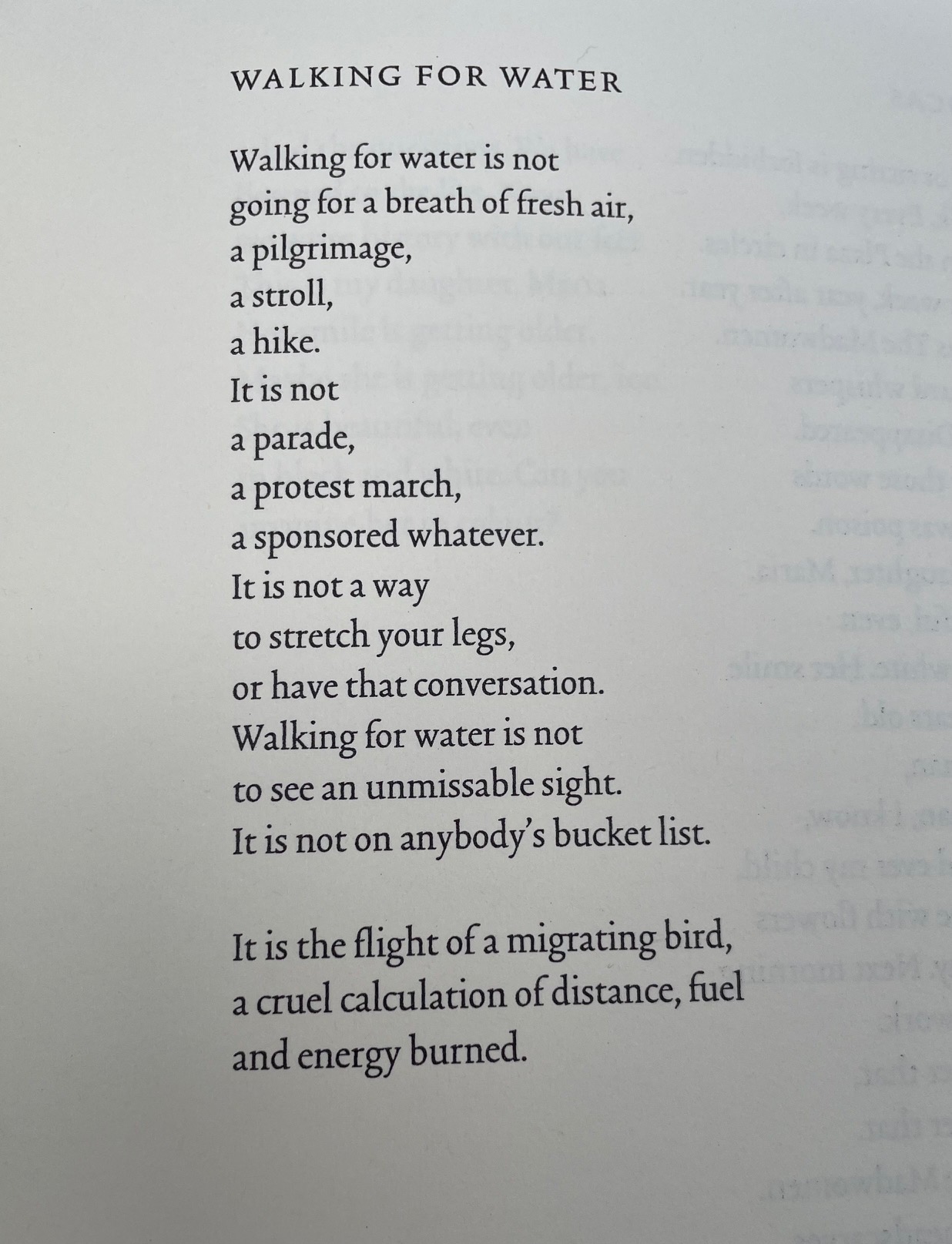
In August, her guest is Anita Roy, no stranger to the walk · listen · create community, having been a volunteer judge for our writing competitions. Anita is a writer, editor and environmentalist. She’ll be reading from her essay, ‘Equinox: The Open Gate’ and Lydia will be reading her poem ‘Walking for Water’ before the conversation turns to the comforts and necessities of walking. This is new territory for Footloose since Anita is technically the first non-poet to join us – but only ‘technically’ because her prose is bursting with poetry – you can read more of her prose by ordering a copy of her most recent published title “Gifts of Gravity and Light”.

Order a copy of “A History of Walking” and “Gifts of Gravity and Light” from our bookshelf.

Lydia will be reading her poem “Walking for Water” that can be downloaded here.

Please pay what you can afford – we’ve set the bar low at €1 euro – revenues will go towards remunerating the poets. We are running an experiment to boost promotion for this event, so if you wish, you can log in to Eventbrite and and book a free ticket there, however, you won’t benefit from joining our 3k+ community of walking artists, performers and writers unless you register here.

Hosts

Lydia Kennaway

Lydia Kennaway

(United Kingdom) 
Anita Roy

Anita Roy

(United Kingdom) 
This event has happened

2022-08-29 18:00
2022-08-29 18:00

Video recording
Online

Footloose

Collection · 10 items
Sub-collection

poetry

6 sub-collections · 198 items

Related

video

Footloose #6 Anita Roy and Lydia Kennaway

This is the sixth instalment of ‘Footloose’, a monthly online event using the subject of walking as a way to explore our inner landscapes.

Lydia Kennaway Anita Roy
Sound walk

A History of Walking

Lydia Kennaway reads selected poems from her book, ‘A History of Walking’.

Lydia Kennaway
walkingevent

Footloose #7 Helen Mort and Lydia Kennaway

Lydia Kennaway talks with poet, walker, runner and climber Helen Mort. They recite poetry, and discuss their work.

Lydia Kennaway Helen Mort
book

Pepper Seed

Shortlisted for the Poetry Prize for First Collection from the Seamus Heaney Centre for Poetry Malika Booker s Pepper Seed is map and compass to a world of distinct yet interconnected landscapes. At home in a number of locales (Brooklyn, Brixton, Trinidad, Guyana, and Grenada) Booker trains a brave eye on the unspeakable and the unspoken. By

Malika Booker
walkingevent

Footloose #5 Jake Morris-Campbell and Lydia Kennaway

Lydia Kennaway reads poems from her pamphlet A History of Walking, and talks to poets and other writers about words and walking. This month's guest is Jake Morris Campbell

Lydia Kennaway Jake Morris-Campbell
book

Heart Murmur

Emma Storr draws on her scientific knowledge and medical experience in deft and lyrical ways to create different voices and styles.

emma storr

pedestrian acts

By de Certeau: In “Walking in the City”, de Certeau conceives pedestrianism as a practice that is performed in the public space, whose architecture and behavioural habits substantially determine the way we walk. For de Certeau, the spatial order “organises an ensemble of possibilities (e.g. by a place in which one can move) and interdictions (e.g. by a wall that prevents one from going further)” and the walker “actualises some of these possibilities” by performing within its rules and limitations. “In that way,” says de Certeau, “he makes them exist as well as emerge.” Thus, pedestrians, as they walk conforming to the possibilities that are brought about by the spatial order of the city, constantly repeat and re-produce that spatial order, in a way ensuring its continuity. But, a pedestrian could also invent other possibilities. According to de Certeau, “the crossing, drifting away, or improvisation of walking privilege, transform or abandon spatial elements.” Hence, the pedestrians could, to a certain extent, elude the discipline of the spatial order of the city. Instead of repeating and re-producing the possibilities that are allowed, they can deviate, digress, drift away, depart, contravene, disrupt, subvert, or resist them. These acts, as he calls them, are pedestrian acts.

Problem?

Encountered a problem? Report it to let us know.

  • Include the page on which you encountered the problem.
  • Describe what happened.
  • Describe what you expected to happen.
Follow us