
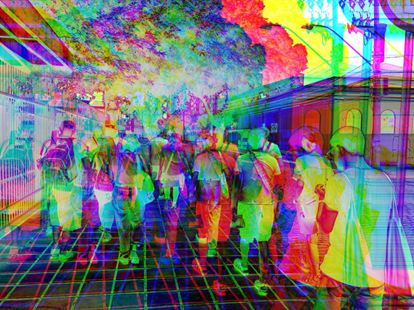
A collective walking action in Brazil and the rest of the world. Open for global participation.
If the walking practices are movements that provide the body with means to read and draw the city through perceptions and sensations caused by the encounters and experiences thathappens during the journey, the extraordinary time of the pandemic drew our attention toresearch, create and propose other ways of walking. The cyberspace dimension, a possible wayof coexisting during the pandemic, is attentive to other possibilities of design, which mayperhaps be called ‘static movement’: while the body is fixed in a certain location of 3D spatialterritory, the restlessness of the mind plays movement. Consequently, the perceptions,relationships and interfaces between everything that is internal and external, public andprivate, whether on concrete or abstract level, start to be revised, while the affections inrelation to already known and unknown places are re-signified.Encouraging actions to promote walking is essential in this time of social distance that we are experiencing. In Brazil, we have a supposed control of coming and going through the so-called“controlled distance” between people. If the year 2020 was marked by periods of greater and lesser confinement, with the second wave of the pandemic, 2021 started in the same way.We live in a continental dimension country, with huge social and economic gaps, where thepandemic arrived to open and outrageously expose this inequality. To draw attention to thesedifferences, we propose to carry out actions that, regardless of the available resources, itbrings us lessons to the recognition and coexistence between different ones. Our preposition can be improved, expanded, adapted, or replicated in different cultures. In this way, webelieve in stimulating a direct dialogue between the tactics and tools used by each hiker in hisregion and its reality.
The cartographic action, Based on these reflections, we are planning to invite people in different Brazilian cities to connect, through the Google Meet platform, on the same day and time, answering the question
In order to use walking as a way to visit, relax, free yourself in the pandemic moment that weare living in, we invite interested participants to answer our question “Why do we walk during pandemia?”, the person will access the link of the event and, for 30 minutes, will be spectator- participant who, while meeting other walkers online, will walk the way they can and want. We suggest recording a video during a journey, talking and walking, dancing whilestrolling, singing and walking, recording the image and the sound of the path, sonorizing theplace where you are or, just drifting.We purpose a virtual action with 3 moments:
After a short introduction, the spectator-participant will walk the path they can and while meeting with other online walkers, for about 30 minutes. We suggest to theparticipating viewers to be online at least 10 minutes before the virtual walk starts. Meeting link.
After the meeting – In the next 30-40 min after the collective walk: conversation with the spectator- participants exchanging impressions and opinions about the experience.
