Search
My feed

Taking it easy

Taking it easy
Multiple locations
Free
Free

Sub-collection

Dérive app

Sub-collection · 3 items

MIT

Collection · 2 items

place

Collection · 195 items

Related

url

BabakFakhamzadeh.com

Personal website of Babak Fakhamzadeh. Babak Fakhamzadeh is a creative technologist, digital artist, and researcher whose work focuses on location-based storytelling, walking art, and participatory media. With a background in mathematics and decades of experience in web and mobile development, he has worked internationally with NGOs, media organisations, and cultural institutions to build digital tools that connect people with place, history, and public space. His projects often combine technology, urban exploration, and narrative, using mobile media and interactive platforms to encourage people to engage with their surroundings in new ways. He is a co-founder of the global walking-arts platform walk · listen · create. Fakhamzadeh is also the creator and maintainer of the Dérive app, a mobile tool that encourages exploratory urban walking inspired by psychogeography. Across his artistic and technical work, he explores how digital tools can reshape how people experience cities, uncover hidden histories, and reclaim agency in navigating the urban environment.

Walking piece

A Walking Poem

'A Walking Poem' is a website that writes psychogeographical poems using real Google Maps directions from your current location to a random place around you.

Javier Arce
walkingevent

World Wide Wander

Join in, for this day-long on-foot festival of creativity, imagination, joy and laughter! It's time, it's free, it's what creative people like you do.

Babak Fakhamzadeh
walkingevent

Urban exploration workshop

On May 25 and 26, together with Dérive app and Placcc, we’re hosting an urban exploration workshop in Budapest. The workshop will focus on the part of the suburb of Erzsébetváros called ‘Csikágó’, Chicago.

Babak Fakhamzadeh
Sub-collection

Dérive app

Sub-collection · 3 items

MIT

Collection · 2 items

place

Collection · 195 items

Related

url

BabakFakhamzadeh.com

Personal website of Babak Fakhamzadeh. Babak Fakhamzadeh is a creative technologist, digital artist, and researcher whose work focuses on location-based storytelling, walking art, and participatory media. With a background in mathematics and decades of experience in web and mobile development, he has worked internationally with NGOs, media organisations, and cultural institutions to build digital tools that connect people with place, history, and public space. His projects often combine technology, urban exploration, and narrative, using mobile media and interactive platforms to encourage people to engage with their surroundings in new ways. He is a co-founder of the global walking-arts platform walk · listen · create. Fakhamzadeh is also the creator and maintainer of the Dérive app, a mobile tool that encourages exploratory urban walking inspired by psychogeography. Across his artistic and technical work, he explores how digital tools can reshape how people experience cities, uncover hidden histories, and reclaim agency in navigating the urban environment.

Walking piece

A Walking Poem

'A Walking Poem' is a website that writes psychogeographical poems using real Google Maps directions from your current location to a random place around you.

Javier Arce
walkingevent

World Wide Wander

Join in, for this day-long on-foot festival of creativity, imagination, joy and laughter! It's time, it's free, it's what creative people like you do.

Babak Fakhamzadeh
walkingevent

Urban exploration workshop

On May 25 and 26, together with Dérive app and Placcc, we’re hosting an urban exploration workshop in Budapest. The workshop will focus on the part of the suburb of Erzsébetváros called ‘Csikágó’, Chicago.

Babak Fakhamzadeh
Walking piece
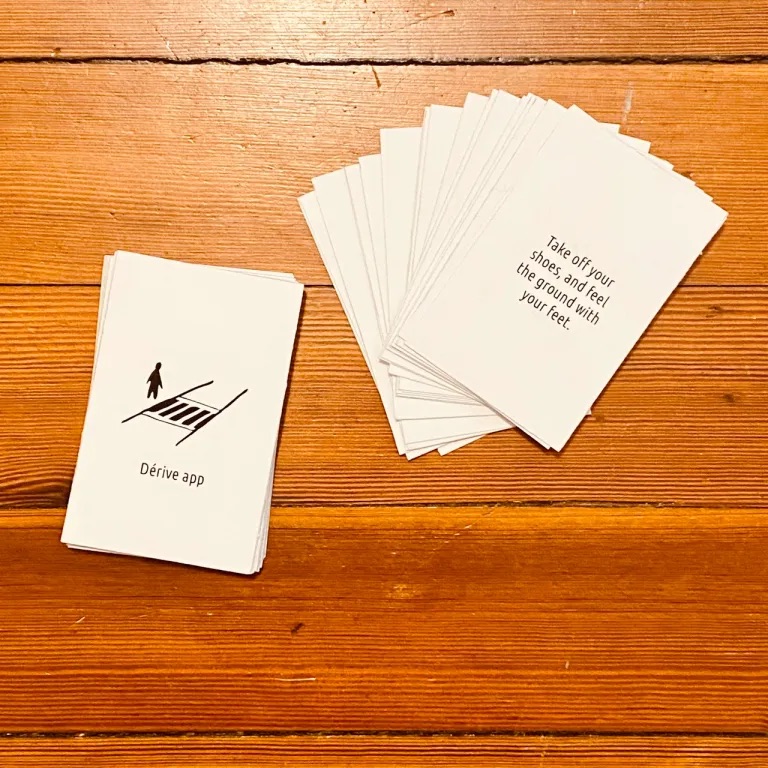
A physical deck of 52 task cards, walking prompts, integrated with Dérive app, developed together with students at MIT and inmates at a juvenile correctional facility.

A physical deck of 52 task cards, walking prompts, integrated with Dérive app.

This deck of task cards was created as part of a class hosted by MIT, called ‘Emotional Intelligence for Teams’.

Participants were equally divided between students at MIT, and juvenile inmates at a correctional facility in Maine.

Besides a physical deck of cards, which can be downloaded, printed, and taken on the road, the user can also use Dérive app, an app for Android and iOS, to play with this new deck.

APA style reference

Fakhamzadeh, B. (2022). Taking it easy. walk · listen · create. https://walklistencreate.org/walkingpiece/taking-it-easy/

Supported by

Dérive app

Dérive app gets you lost in your city and lets you share that experience with others.
Babak Fakhamzadeh

pedestrian acts

By de Certeau: In “Walking in the City”, de Certeau conceives pedestrianism as a practice that is performed in the public space, whose architecture and behavioural habits substantially determine the way we walk. For de Certeau, the spatial order “organises an ensemble of possibilities (e.g. by a place in which one can move) and interdictions (e.g. by a wall that prevents one from going further)” and the walker “actualises some of these possibilities” by performing within its rules and limitations. “In that way,” says de Certeau, “he makes them exist as well as emerge.” Thus, pedestrians, as they walk conforming to the possibilities that are brought about by the spatial order of the city, constantly repeat and re-produce that spatial order, in a way ensuring its continuity. But, a pedestrian could also invent other possibilities. According to de Certeau, “the crossing, drifting away, or improvisation of walking privilege, transform or abandon spatial elements.” Hence, the pedestrians could, to a certain extent, elude the discipline of the spatial order of the city. Instead of repeating and re-producing the possibilities that are allowed, they can deviate, digress, drift away, depart, contravene, disrupt, subvert, or resist them. These acts, as he calls them, are pedestrian acts.

Problem?

Encountered a problem? Report it to let us know.

  • Include the page on which you encountered the problem.
  • Describe what happened.
  • Describe what you expected to happen.
Follow us