Search
My feed

Curated News

Collection · 1063 items

Related

Curated news

“Just Keep Walking” Virtual Challenge — Water For South Sudan

Water matters and access to it means communities can improve their overall health and economy, women can start small businesses to support their families. Walking together as a global community, we will help drill a new well in a South Sudan village. Source: “Just Keep Walking” Virtual Challenge — Water For South Sudan

Curated news

William records audio walking tour for Apple – The Irish News

The Duke of Cambridge talks about the importance of keeping mentally fit and reflects on a lighter moment when he was drawn out of his comfort zone. Source: William records audio walking tour for Apple – The Irish News

Curated news

This artist uses a frozen Finland lake as his massive canvas

Architect-designer Pasi Widgren turns frozen lakes in Finland into canvases, using a snow shovel to create artwork on the ice. Source: This artist uses a frozen Finland lake as his massive canvas

Curated news

A San Francisco Soundwalk

Source: A San Francisco Soundwalk

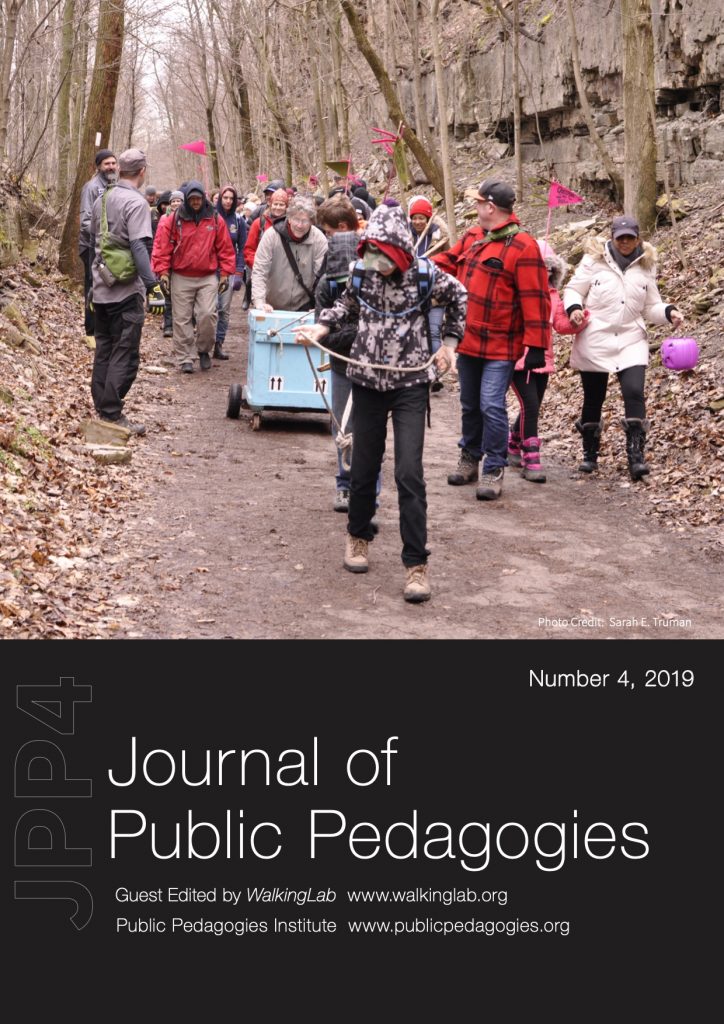
Journal | Public Pedagogies Institute

Source: Journal | Public Pedagogies Institute

Submitted by: Geert Vermeire

pedestrian acts

By de Certeau: In “Walking in the City”, de Certeau conceives pedestrianism as a practice that is performed in the public space, whose architecture and behavioural habits substantially determine the way we walk. For de Certeau, the spatial order “organises an ensemble of possibilities (e.g. by a place in which one can move) and interdictions (e.g. by a wall that prevents one from going further)” and the walker “actualises some of these possibilities” by performing within its rules and limitations. “In that way,” says de Certeau, “he makes them exist as well as emerge.” Thus, pedestrians, as they walk conforming to the possibilities that are brought about by the spatial order of the city, constantly repeat and re-produce that spatial order, in a way ensuring its continuity. But, a pedestrian could also invent other possibilities. According to de Certeau, “the crossing, drifting away, or improvisation of walking privilege, transform or abandon spatial elements.” Hence, the pedestrians could, to a certain extent, elude the discipline of the spatial order of the city. Instead of repeating and re-producing the possibilities that are allowed, they can deviate, digress, drift away, depart, contravene, disrupt, subvert, or resist them. These acts, as he calls them, are pedestrian acts.

Problem?

Encountered a problem? Report it to let us know.

  • Include the page on which you encountered the problem.
  • Describe what happened.
  • Describe what you expected to happen.
Follow us