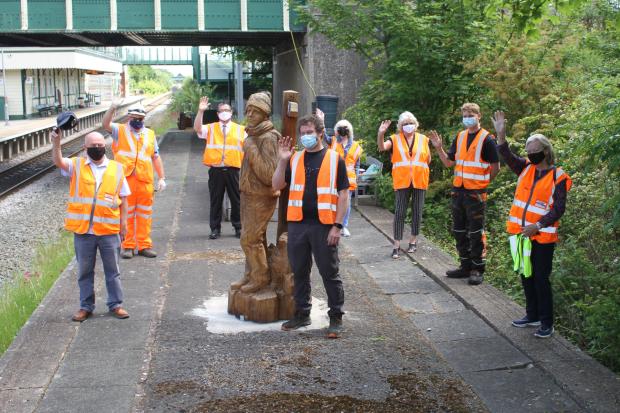
RAIL passengers passing through Prestatyn now have an eye-catching reminder of the resort’s status as a “Walkers are Welcome” town.
Source: Prestatyn Walker Sculpture now in place on disused platform | Rhyl Journal
In the light of the UK government’s crackdown on slow-walking protests, this comment from Council of Europe makes interesting reading – Strasbourg 02/06/2023 Source: Crackdowns on peaceful environmental protests should stop and give way to more social dialogue – Commissioner for Human Rights
Ordnance Survey reveals the hikes most enjoyed by the British public over the past 12 months, according to its app Source: Britain’s 10 most popular walks – according to the OS map app | Walking holidays | The Guardian
The unique exhibition does not limit itself with a mere showcasing of structures. It opens up a portal to a unusual world of art Source: A walk through Poro-City: Where architecture meets art | The Business Standard
Dubai has a new walking club that is helping women to exercise, socialise and network. Source: ‘Girls Who Walk Dubai’: How a new mum is empowering and connecting women in Dubai by simply walking | Friday-art-people – Gulf News
RAIL passengers passing through Prestatyn now have an eye-catching reminder of the resort’s status as a “Walkers are Welcome” town.
Source: Prestatyn Walker Sculpture now in place on disused platform | Rhyl Journal
pedestrian acts
By de Certeau: In “Walking in the City”, de Certeau conceives pedestrianism as a practice that is performed in the public space, whose architecture and behavioural habits substantially determine the way we walk. For de Certeau, the spatial order “organises an ensemble of possibilities (e.g. by a place in which one can move) and interdictions (e.g. by a wall that prevents one from going further)” and the walker “actualises some of these possibilities” by performing within its rules and limitations. “In that way,” says de Certeau, “he makes them exist as well as emerge.” Thus, pedestrians, as they walk conforming to the possibilities that are brought about by the spatial order of the city, constantly repeat and re-produce that spatial order, in a way ensuring its continuity. But, a pedestrian could also invent other possibilities. According to de Certeau, “the crossing, drifting away, or improvisation of walking privilege, transform or abandon spatial elements.” Hence, the pedestrians could, to a certain extent, elude the discipline of the spatial order of the city. Instead of repeating and re-producing the possibilities that are allowed, they can deviate, digress, drift away, depart, contravene, disrupt, subvert, or resist them. These acts, as he calls them, are pedestrian acts.
Encountered a problem? Report it to let us know.
You must be logged in to post a comment.