Search
My feed
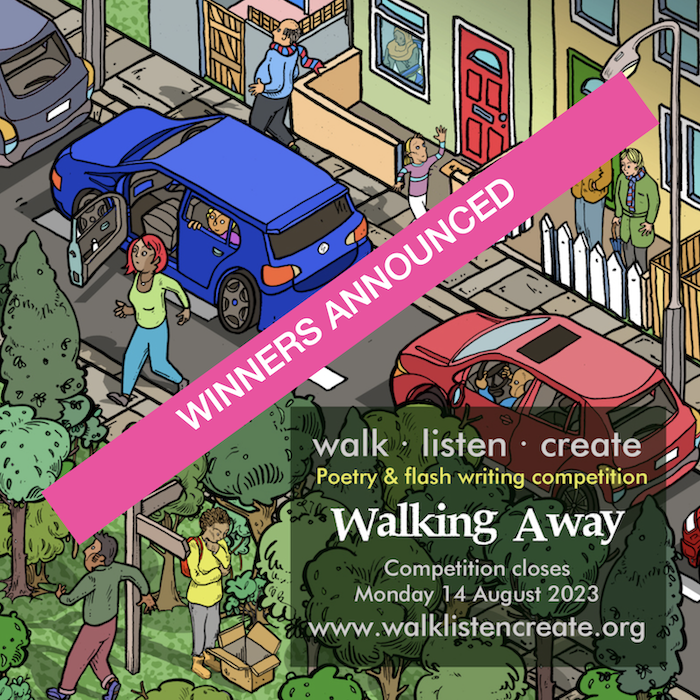
Walking A:way Winners Announced

Walking A/way with the prizes…

At the Sound Walk Stories Sunday showcase event of new writing, at which the shortlisted poems and stories from our 2023 Walking A/way themed writing competition, were read by their inspiring authors, we learnt which of them walked away with the prizes.

Frequent attendee of Walking Writers’ Salons, Amelia Hodsdon told us that her winning story “arrived fully formed”. Entitled I could, You know, I could is something she often thinks about after she has walked her kids to school, savouring some magical realism on the way home. Amelia “was also inspired by the recent Walking Writers’ Salon event with the writer Gail Simmons, and her mention of the Long Man of Wilmington chalk figure. Where is the line between dream and reality, and how will we be remembered?”

Tree-lover Shani Cadwallender who was unable to attend the showcase, wrote about what inspired her to write her winning poem stump speech: “This piece was inspired by my research for my creative-critical PhD project at Birkbeck, which is about the representative strategies used by marginal women poets of the nineteenth century to depict trees. Jonathan Bate’s excellent recent book, ‘Radical Wordsworth’, makes the connection between metrical feet and literal ones, which my poem picks up in a consideration of how positionality shapes the types of nature to which we are exposed, and over which we feel ‘ownership’.” 

So impressive was the quality of poems submitted in the competition, that poetry judges, Ralph Hoyte and this year’s poet-in-residence Tony Horitz, chose two poems as runners-up. They were Serenade by EilÍn de Paor and Anna in the Ashes by Jan Martin. Chris Cuninghame‘s East of Woolwich was the runner-up in the story category.

Winners receive Silver membership of walk · listen · create for a year and the honour of becoming our 2023/4 online writers-in-residence, and so will be choosing the theme for next year’s competition. They also win, as do the runners-up, a print of the artwork that Alban Low created in response to their pieces.

Congratulations to all the shortlisted authors: Ricky Abbott, Shani Cadwallender, Kevin Cheeseman, Lorraine Collins, Chris Cuninghame‘, EilÍn de Paor , Amelia Hodsdon, Rosaleen Lynch, Jan Martin, Isabela Mead, and Richard Westcott.

You can purchase a copy of WALKING 23, the anthology of all shortlisted pieces, from our online shop.

We would like to thank R.M. Francis who expertly compered the showcase; Cheryl Markosky and Tony Horitz who each read work they had created during their online residencies, as well as acting as judges; joined in judging by Ralph Hoyte and S.A.Greene. We would especially like to thank Alban Low for his beautiful artwork, and Chris Bestwick for editorial, and to both of them for publishing the anthology.

APA style reference

Stuck, A. (2023). Walking A/way with the prizes…. walk · listen · create. https://walklistencreate.org/2023/09/24/walking-a-way-with-the-prizes/
Long Man, UK
Sub-collection

creative writing

Sub-collection · 166 items
Sub-collection

Walking writing

Sub-collection · 94 items

Related

video

Finding a Place – creative critical wanderings in landscape with guest Dr Anna Burton

Finding a Place - creative critical wanderings in landscape with guest Dr Anna Burton and hosts Shani Cadwallender, Poet-in-Residence and Amelia Hodsdon, Writer-in-Residence for walk · listen · create.

Andrew Stuck Shani Cadwallender +2
book

Call of the Undertow

A novel which majors on landscape written by Linda Cracknell who was inspired by walking in Caithness. When Maggie Thame, a childless forty-something from Oxford, relocates to a remote village at Scotland’s most northern edge, it’s clear she’s running away. But to the villagers the question remains, from what? Pursuing her career as a freelance

Linda Cracknell
post

“Walking Home” writing competition winners announced

We are delighted to announce the winners of our walking home writing competition: Tony Horitz for his poem ‘Of Blood and Water‘ and Cheryl Markosky for her story ‘Walk of Life‘. At the Stories Sunday Showcase event hosted by Jake Morris-Campbell poet and broadcaster, with special guest Lydia Kennaway, outgoing Poet-in-Residence, the competition short listers

Andrew Stuck
video

Walking creatively through storytelling with Krista Carson

A Walking Writers Salon with  Krista Carson (writer, poet, educator, and PhD student), offers insights from her practice-based doctoral work where she is exploring the relationship between walking and creativity. Her book-in-progress weaves together prose and poetry framed by walks she has taken (often literal, sometimes figurative). She ponders uncertainty, transformation, and becoming as she moves

Krista Carson Andrew Stuck
post

Walking Around the Internet

Walking around the Internet with Amelia Hodsdon our writer-in-residence

Amelia Hodsdon
CC-BY-NC: Andrew Stuck

One thought on “Walking A/way with the prizes…

pedestrian acts

By de Certeau: In “Walking in the City”, de Certeau conceives pedestrianism as a practice that is performed in the public space, whose architecture and behavioural habits substantially determine the way we walk. For de Certeau, the spatial order “organises an ensemble of possibilities (e.g. by a place in which one can move) and interdictions (e.g. by a wall that prevents one from going further)” and the walker “actualises some of these possibilities” by performing within its rules and limitations. “In that way,” says de Certeau, “he makes them exist as well as emerge.” Thus, pedestrians, as they walk conforming to the possibilities that are brought about by the spatial order of the city, constantly repeat and re-produce that spatial order, in a way ensuring its continuity. But, a pedestrian could also invent other possibilities. According to de Certeau, “the crossing, drifting away, or improvisation of walking privilege, transform or abandon spatial elements.” Hence, the pedestrians could, to a certain extent, elude the discipline of the spatial order of the city. Instead of repeating and re-producing the possibilities that are allowed, they can deviate, digress, drift away, depart, contravene, disrupt, subvert, or resist them. These acts, as he calls them, are pedestrian acts.

Problem?

Encountered a problem? Report it to let us know.

  • Include the page on which you encountered the problem.
  • Describe what happened.
  • Describe what you expected to happen.
Follow us