Walking Landscapes is a project dedicated to exploring the interconnectedness of walking, art, and cultural geography. It curates and presents a diverse range of walking-based artistic practices and research, emphasizing how walking as an embodied experience shapes and reflects cultural, social, and environmental landscapes. The platform features detailed case studies, artist projects, and scholarly essays that investigate walking as a method of inquiry and creative expression, highlighting its role in mapping places, histories, and personal narratives.
The website also serves as a resource hub for those interested in the interdisciplinary field of walking art, showcasing walking routes, sound walks, performance walks, and other experimental approaches that utilize the act of walking to engage with different urban and rural environments. By documenting these practices, Walking Landscapes contributes to a deeper understanding of place-making and spatial relations, as well as the ways walking practices intersect with memory, identity, and ecology.
Most recent articles
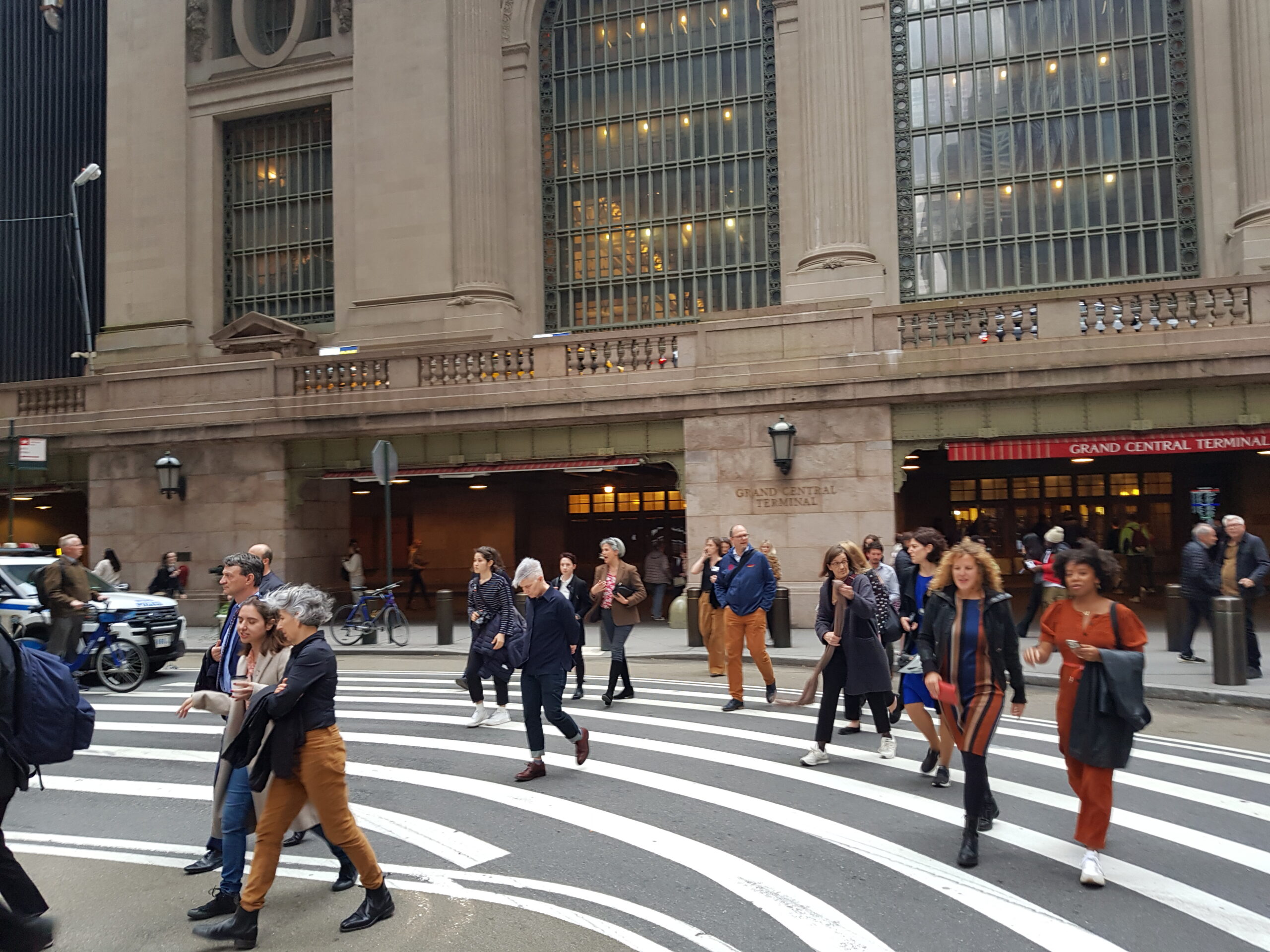
Video Resilience Walk Grand Central
Watch the video that Frederik Stähling and I made about our Resilience Walk in Grand Central. I guided 30 Experts on resilience from different professional backgrounds one hour through Grand Central Terminal experiencing and questioning Grand Central´s resilience and translating the abstract concept of resilience to a specific place. Many thanks to Jan Lüdert, Ph.D. DWIH […]
Resilience Walk in New York City
On October 19, 33 speakers of this year’s DWIH Future Forum https://www.dwih-futureforum.org/program-2023 joined the RESILIENCE WALK through Grand Central Terminal in New York City. My design of the walk combined walking in silence, walking and talking and intervening into the complex and beautiful infrastructure of Grand Central. It inspired the participants to exchange and test […]
Talking about Walking, Storytelling and Mapping at Rutgers, New Jersey, USA
I am very honored to give the 2022 Steve Strom Memorial Lecture at Rutgers School of Environmental and Biological Sciences, Department of Landscape Architecture on October, 26. Opening processes of landscape planning and design to people of diverse backgrounds is key as all are needed in making landscapes more resilient to climate change. I will circe around […]
Two new videos on walking as co-creative practice online
Walking can be a means of co-creative design practice in transforming landscapes. The explorative walks through Osnabrück´s Green Fingers triggered arguments on conflicting objectives on how to create a climate-resilient city – all embedded in and inspired by a co-creative atmosphere of walking together. And the walks through the western parts of Munich’s greenbelt allowed […]
My thoughts on Metropolitan Trails
Read my short review on the wonderful project “Metropolitan Trails”. https://metropolitantrails.org/en Topic and relevance The approach of metropolitan trails is highly relevant as it considers paths / trails as important infrastructure in metropolitan regions. The trails shown on https://metropolitantrails.org/en/trails lead through areas that are usually not seen as terrain for walking, wandering or […]
Review in Bücherrundschau
This year’s „Bücherrundschau“ by Herbert Pardatscher-Bestle mentions my book “Landschaften auf den Grund gehen” as “compelling and valuable”. Great to see that people are inspired by experimenting with walking as practise of design research and practis...
Visions and Paths to a Resilient City
The Tempelhofer Feld in Berlin – an exemplary feature of a climate-resilient city structure? During the pandemic it provided open space to exercise, to experience the changing seasons and to enjoy being OUTside withIN the city while easily maintaining distance to others. My virtual talk at Goethe Institut, Moskau (June 15, 2021), focuses on visions […]
Talk „Pathscapes. Designing Munich´s Green Belt“ at AESOP Conference Regional Design
How can Munich´s green belt be appreciated, designed as open space, protected as biodiverse habitat as well as qualified for landscape-related recreation? At AESOP Conference “Regional Design”, I reflected on how walking workshops and co-creatively designing pathscapes can be a tool to approach this question. Taking the project “Paths form landscape” as an example, I […]
New publication: Tools for Designing Riverscapes Co-creatively. Walk! Find Typologies! Design Spatial Visions!
Successfully transforming riverscapes depends on regional cooperation and transdisciplinary collaboration. Spurred on by the European Water Framework Directive, many European regions are working on improving the ecological quality of rivers and reshaping the adjacent landscapes. So, planning teams consisting of landscape architects, urban planners, architects and ecologists work on integrated strategies for designing sustainable riverscapes. […]
Publication “Wege machen Landschaft” in Stadt+Grün
Find the text “Wege machen Landschaft. Landschaftsbezogenes Wegekonzept für den Münchner Grüngürtel” written by Matthias Lampert, Börries v. Detten and me in the current issue of “Stadt + Grün” here: https://stadtundgruen.de/art...
Walking Green Fingers to create Awareness for Climate-Resilience: Videos online
Watch the interview on our project “Productive. Sustainable. Lively. Green fingers for climate-resilient Osnabrück”, funded by BMBF, online: https://www.nachhaltige-zukunftsstadt.de/im-gespraech/henrik-schultz/ (© Gröschel Branding, Berlin ...
Presenting “Paths lead to Landscapes” in Munich
Börries von Detten and I presented our study on paths trough Munich´s Green belt (November 13, Munich) and discussed our findings with experts from the region. One conclusion was that working co-creatively on the green spaces between the municipalities is key to qualifying quality of life in the city region. A resilient network of […]
Symposium in Munich on Paths and Landscapes
Landscapes are made through walking and paths. Börries von Detten and Henrik Schultz present their ideas for a new concept of landscape paths for Munich´s green fringe and discuss their findings with experts form Vienna, Frankfurt and the region of Mun...
Transformative Science Walk in Osnabrück
The third walk through the “green fingers” of Osnabrück, backbones of the climate-resilient city of the future, took place September 28 and brought together a diverse group of stakeholders. Representatives of associations, politicians, farmers and citizens walked the green fingers for five hours and discussed challenges, talents and ideas for the future. “A good mixture. […]
Walk with me! How walking inspires designing
The new book “Design Research for Urban Landscapes” is out there now! It addresses in particular PhD Students and advisors telling success stories of integrating design research into PhDs. My chapter “Walk with me! How walking inspire...
Urban Landscapes in Motion: Join book launch August 27!
I am thrilled to be part of the book launch Design Research for Urban Landscapes featuring a keynote of Prof. Dr. Ottmar Ette presenting his thoughts on “science on the move”, based on his extensiv research on Alexander von Humboldt (1769-1859). The book can seen as a translation of Humboldt´s´s findings into contemporary design research. Design […]
Save the Date: Book launch “Design Research for Urban Landscapes – Theories and Methods”
A team of Studio Urbane Landschaften will introduce the new book “Design Research for Urban Landscapes – Theories and Methods”, on August 27, 2019 at Humboldt-Universität zu Berlin. We are especially proud to announce the expert on science ...
First Finger-Walk in Osnabrück
A vital part of the research project “Produktiv. Nachhaltig. Lebendig. Grüne Finger für eine klimaresiliente Stadt” are walks with different groups of people through Osnabrücks so called “Green Fingers”. On May 18 members of the “Bürgerbeirat” walked the green finger Sandbachtal and discussed perceptions, identified relevant questions and found ideas for the future of one […]
Walking – ways to intervene and creatively disturb
In my talk “Interventionen. Produktive Störung und Kommunikationsanlass” at RWTH Aachen (May 13) I presented my thoughts on walking as means to creatively disturb everyday practices. RWTH is working together with the City of Aachen on a walkability-project and focussing on urban interventions to tackle the associated transformation of public space. Referring to my own […]
Talk in Halle: Multilocality and urban-rural meshworks
In my talk „Das Land als Sphäre der Verortung einer multilokalen Gesellschaft?“ during the conference “Gutes Leben auf dem Land” (July 5, 2018) I presented my thoughts on new interdependencies between urban and rural spaces initiated through new forms of being “en route”. I understand multilocality as a result of structural necessity, action capacity and […]
Related
Walking@Teatime Walking and Creativity
The Active Travel Academy at the University of Westminster and London Living Streets invite you to join us on-line on 11th May at 5pm when Walking@Tea-time will celebrate the Spring. Our subject is walking and creativity and we’ll be ably assisted by two speakers: Matthew Beaumont is a Professor of English Literature and a Co-Director of
Meet Morag, author of The Feminist Art of Walking
Here’s an invitation that we know you won’t be able to refuse: Morag Rose offers a huge thank you to everyone who has helped make The Feminist Art of Walking. Tickets are now available for all dates on her book publicity tour – your chance to meet Morag in person*: Juno Books, Sheffield Saturday 18th
Code as Prosthesis
The website "Code as Prosthesis" serves as an online platform exploring the intersections between code, technology, and human experience through an artistic and theoretical lens. It presents a collection of essays, projects, and artworks that investigate how code functions not only as a tool but also as an extension or augmentation of the body and mind. The content engages with themes related to digital embodiment, posthumanism, and the ways computational practices reshape perception, identity, and our interaction with space and culture. Structured around contributions from diverse artists, theorists, and researchers, the site delves into critical and speculative approaches to understanding code beyond its technical dimensions. It situates code within broader cultural and philosophical contexts, addressing its role in contemporary art practices and questioning normative relationships between human and machine. The material reflects a multidisciplinary inquiry, combining insights from media theory, cybernetics, and cultural geography to emphasize the prosthetic nature of technological interfaces in mediating lived experience.

You must be logged in to post a comment.