Search
My feed

The Walking Body 4

TWB4

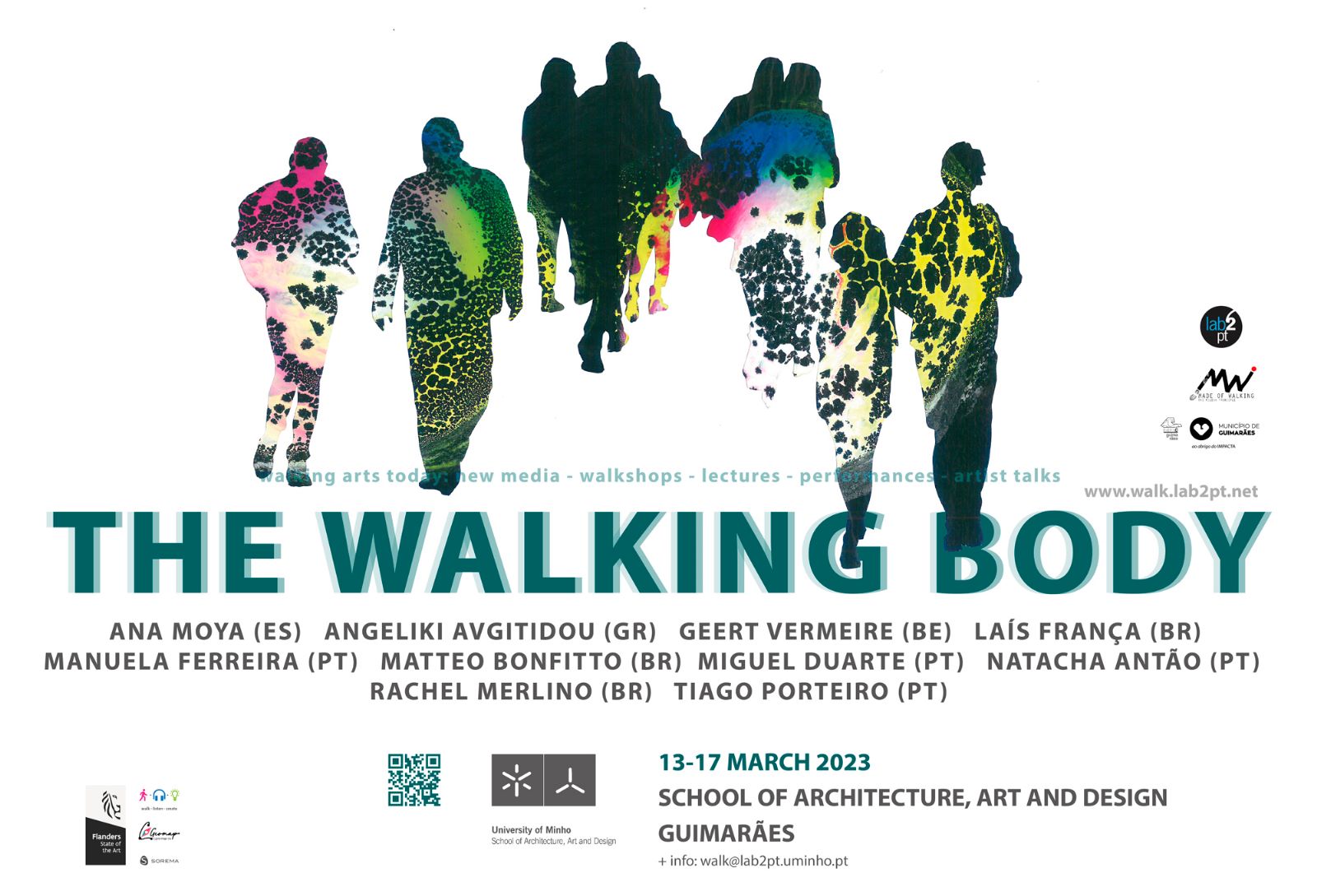
The Walking Body 4 (TWB4) is an international gathering of walking artists, organized since 2018, in the Portuguese city of Guimarães, at Bairro C and the Art Gallery Garagem Avenida/EAAD. The 4th edition is taking place between March 13rd and 17th, 2023.
It includes a week of workshops and a presentation of the work of national and international walking artists.
Artists, students, interested parties and the inhabitants of the city of Guimarães are invited to interact with the territory and walk together, inspired by in situ walkshops with the artists..

Artists at TWB4 are: Ana Moya (ES), Angeliki Avgitidou (GR), Geert Vermeire (BE), Laís França (BR), Matteo Bonfitto (BR), Manuela Ferreira (PT), Miguel Duarte (PT), Natacha Antão (PT), Rachel Merlino (BR) e Tiago Porteiro (PT).

The Walking Body is conceived and organized by Geert Vermeire (Made of Walking/walk · listen · create), Miguel Bandeira Duarte (EAAD/Lab2PT) and Natacha Antão Moutinho (EAAD/Lab2PT).

It is organized by Lab2PT, in partnership with the School of Architecture, Art and Design, and has the institutional support of the University of Minho.

Full program: https://walk.lab2pt.net/twb-4/

Hosts

Geert Vermeire

Geert Vermeire

co-founder of walk · listen · create (Belgium) 
Miguel Bandeira Duarte

Miguel Bandeira Duarte

(Portugal) 
Natacha Moutinho

Natacha Moutinho

I'm going for a walk and I'll never come back (Portugal) 
This event has happened

13 - 17 Mar, 2023
13 - 17 Mar, 2023

Guimaraes, Portugal

Conference

Collection · 13 items

workshops

Collection · 20 items

Related

Walking piece

Libraries as Gardens – sound walk in Athens

The National Garden of Athens hosts an interactive audio project featuring global participants sharing stories and readings about their favorite public gardens during the pandemic, accessible via a mobile webapp or desktop map. This evolving sound walk includes lockdown silence recordings and aims to create a geolocated audio archive of personal and public garden experiences before, during, and after COVID-19.

Geert Vermeire
walkingevent

Walking as a Question – pre-premiere of Prespa’s “is Walking art?”

Pre-premiere of documentary "Is Walking Art" - Premiere of the publication Prespa 2019 and meet up Walking Arts Encounters/Conference Prespa 2019 & 2021

Christos Ioannidis Geert Vermeire +1
post

Call for soundwalks at ICMC

The 2025 International Computer Music Conference (ICMC) is one of the discipline’s largest and most prestigious gatherings of sound artists, composers, media artists, and scholars. This year ICMC will be held in Boston from June 8-14, 2025.

Amber Vistein
url

Sukarma Thareja

A personal academic and professional site providing detailed information about Dr. Thareja’s educational background, research interests, publications, and professional achievements. The homepage features an introduction to Dr. Thareja, outlining her expertise in linguistics, cognitive science, and language education, along with a summary of her contributions to these fields. The site additionally includes sections such as research projects, conference presentations, and links to published papers, serving as a comprehensive resource for those interested in her scholarly work. The website is designed primarily for an audience of academic peers, students, and professionals interested in linguistics and cognitive research, providing a clear overview of Dr. Thareja’s contributions and ongoing scholarly activities.

walkingevent

The Walking Body 3

The Walking Body 3 (TWB3) "Lines and steps, weaving words and walks" is an international encounters of walking artists in Guimarães (Portugal). Walkshops, artist's talks and a conference are held in and around the Alberto Sampaio Museum the Soiedade Martins Sarmento Museum and the School of Arts / EAAD.

Geert Vermeire Miguel Bandeira Duarte +6

pedestrian acts

By de Certeau: In “Walking in the City”, de Certeau conceives pedestrianism as a practice that is performed in the public space, whose architecture and behavioural habits substantially determine the way we walk. For de Certeau, the spatial order “organises an ensemble of possibilities (e.g. by a place in which one can move) and interdictions (e.g. by a wall that prevents one from going further)” and the walker “actualises some of these possibilities” by performing within its rules and limitations. “In that way,” says de Certeau, “he makes them exist as well as emerge.” Thus, pedestrians, as they walk conforming to the possibilities that are brought about by the spatial order of the city, constantly repeat and re-produce that spatial order, in a way ensuring its continuity. But, a pedestrian could also invent other possibilities. According to de Certeau, “the crossing, drifting away, or improvisation of walking privilege, transform or abandon spatial elements.” Hence, the pedestrians could, to a certain extent, elude the discipline of the spatial order of the city. Instead of repeating and re-producing the possibilities that are allowed, they can deviate, digress, drift away, depart, contravene, disrupt, subvert, or resist them. These acts, as he calls them, are pedestrian acts.

Problem?

Encountered a problem? Report it to let us know.

  • Include the page on which you encountered the problem.
  • Describe what happened.
  • Describe what you expected to happen.
Follow us