Search
My feed

Walking in the Anthropocene – Planetary Walking

Supercluster

Walking arts today became a response to the deep environmental  global crisis we are facing today.  Walking is one of the keys to contextualize and deepen our understanding and relation with the planet place we live on. It is more and more clear that the future will be ecological or there will not be a future for our species.         

Walking our planet is the opportunity to explore this question.  The sounds, the living creatures, the plants, the geopoetics of every place are some of the factors that connect us to a Nature that is experienced and lived. Walking in and beyond Prespa is stepping out of the time and space of the man-made environment, entering in a no man’s land of nature, bringing us back what was before and to where we belong.

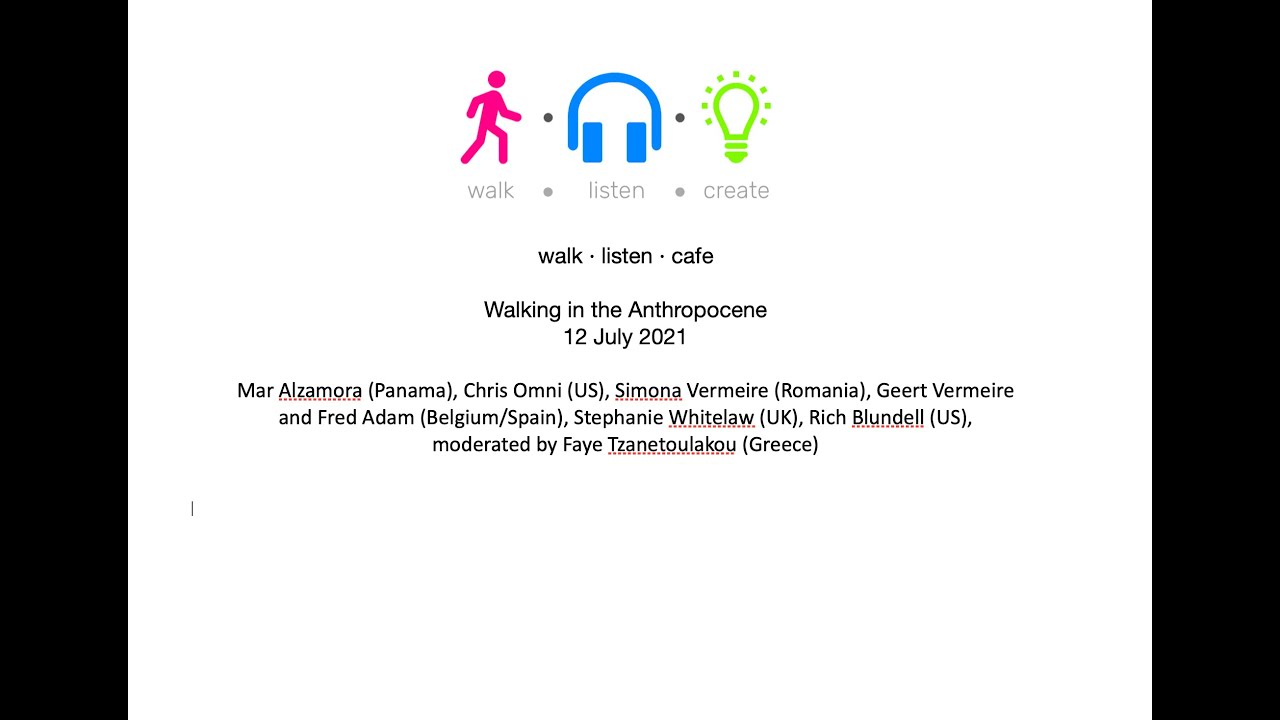
Speakers are Mar Alzamora (Panama), Chris Omni (US), Simona Vermeire (Romania), Geert Vermeire and Fred Adam (Belgium/Spain), Stephanie Whitelaw (UK), Rich Blundell (US), moderated by Faye Tzanetoulakou.
The speakers were asked to provide a presentation of their work, in preparation for the café:

Walk Listen Café @ WAC brings scholars and artists together around their research and their practices related to walking arts in a series of 8 online meet ups and conversations. Prerecorded paper presentations and other media will be available in this post at least 48 hours before the Walk Listen Café starts, and the participants are requested to look into the online materials before joining the Café.

Hosts

Faye Tzanetoulakou

Faye Tzanetoulakou

 
Mar Alzamora

Mar Alzamora

 
Simona Vermeire

Simona Vermeire

 
Stephanie Whitelaw

Stephanie Whitelaw

 
Chris Omni

Chris Omni

 
Fred Adam

Fred Adam

(Spain) 
Geert Vermeire

Geert Vermeire

co-founder of walk · listen · create (Belgium) 
This event has happened

Walking as a Question

4 - 17 Jul, 2021 · 109 items

2021-07-12 18:00
2021-07-12 18:00
2021-07-12 18:00

Walking in the Athropocene video recording
Only available to registered users.
Online

walk · listen · café

Collection · 114 items

Related

video

Walking in the Anthropocene – Planetary Walking

Walking arts today became a response to the deep environmental global crisis we are facing today. Walking is one of the keys to contextualize and deepen our understanding and relation with the planet place we live on. It is more and more clear that the future will be ecological or there will not be a future for our species.

Faye Tzanetoulakou Mar Alzamora +5
Sound walk

Soundwalk: “Aquí habita un río” (A river lives here)

This post explores the relationship between Panama City and its urban waterways through a multisensorial soundwalk along the six-kilometer Matasnillo River, the most polluted in the area. It offers an open letter reflecting on what the river reveals about the environment and human connection from its source to the ocean.

Mar Alzamora
Sound walk

Waterwalk

Waterwalk is an interactive, sensory-based guided walk exploring the relationship between internal and external water through meandering movement and thematic engagement with water elements. Designed for a twenty-minute experience, it can be undertaken physically or mentally, in any environment, and includes instructions to drink water during the walk.

Stephanie Whitelaw
Walking piece

Soles of Black Women: Walking Art as a Means to Reverse Engineer the Strong Black Woman Phenomena

Dr. Chris Omni's doctoral research on Black Joy in Green Spaces is now presented as a walking art performance that encourages Black women to prioritize rest. This piece is filmed in a way that poetically invites audiences to walk in the shoes of BW.

Chris Omni
Walking piece

Libraries as Gardens – sound walk in Athens

The National Garden of Athens hosts an interactive audio project featuring global participants sharing stories and readings about their favorite public gardens during the pandemic, accessible via a mobile webapp or desktop map. This evolving sound walk includes lockdown silence recordings and aims to create a geolocated audio archive of personal and public garden experiences before, during, and after COVID-19.

Geert Vermeire
walkingevent

Walking as Artistic Practice 

We are excited to have Ellen Mueller as our guest for this Cafe. For the last few years, she has been compiling a comprehensive resource on walking art and sharing it through her blog and through her own teaching resources. However, she is now the author of recent book from SUNY Publishers that brings together

Ellen Mueller Andrew Stuck
walkingevent

On Cybernetic Capitalism

We welcome back Bob Parks. Bob was one of the pioneers of performance art in England in the 1960s, and on the US West Coast in the 1970s, and eventually has seen his practice evolve into a mixture of performance and walking art, subscribing to the idea that Walking Art is Performance Art on wheels, with the capacity to bring in the whole world's population.

Bob Parks
walkingevent

Flaneurs, Fascists, and People Smugglers (Small Boats, Long Walks)

What goes on at Europe's borders, out of sight and out of mind? Simon Cole always loved the film Casablanca. Then 2020s life began to imitate 1940s art. Let's tease out treasure from the corridors of historical uncertainty.

Simon Cole
walkingevent

Into the Night: An Evening of Nocturnal Wanderings

A gathering on the night before the longest night. This is the nocturnal world, the place we walk illuminated by constellations of twinkling skies and powerful planets; the locale where our perambulations offer other ways of dwelling and sensing our being in the world and its myriad human and non-human presences. Join us as we stroll together, physically and conceptually, sharing our stories, experiences, feelings, senses and night-time reveries. An evening with the moon and Fay Stevens.

Fay Stevens

pedestrian acts

By de Certeau: In “Walking in the City”, de Certeau conceives pedestrianism as a practice that is performed in the public space, whose architecture and behavioural habits substantially determine the way we walk. For de Certeau, the spatial order “organises an ensemble of possibilities (e.g. by a place in which one can move) and interdictions (e.g. by a wall that prevents one from going further)” and the walker “actualises some of these possibilities” by performing within its rules and limitations. “In that way,” says de Certeau, “he makes them exist as well as emerge.” Thus, pedestrians, as they walk conforming to the possibilities that are brought about by the spatial order of the city, constantly repeat and re-produce that spatial order, in a way ensuring its continuity. But, a pedestrian could also invent other possibilities. According to de Certeau, “the crossing, drifting away, or improvisation of walking privilege, transform or abandon spatial elements.” Hence, the pedestrians could, to a certain extent, elude the discipline of the spatial order of the city. Instead of repeating and re-producing the possibilities that are allowed, they can deviate, digress, drift away, depart, contravene, disrupt, subvert, or resist them. These acts, as he calls them, are pedestrian acts.

Problem?

Encountered a problem? Report it to let us know.

  • Include the page on which you encountered the problem.
  • Describe what happened.
  • Describe what you expected to happen.
Follow us