Search
My feed

TRACE: A Remote Geography of the Mind

TRACE: A Remote Geography of the Mind_screenshot
Multiple locations

Sub-collection

artistic research

Sub-collection · 14 items
Sub-collection

GPS

Sub-collection · 26 items

Trace

Collection · 7 items

Related

Walking piece

Drawing Cartographies of Perception

This walkshop explores the personal and subjective nature of navigation and cartography and the diverse ways people perceive and move through space, using the acts of walking and drawing as primary methods of investigation.

Christopher Kaczmarek
Walking piece

Walk in the City – Walking as a Protest

A 50 mins recording of a live streamed walk presented as part of the Advanced Master in Artistic Research in Social and Political Context - Sint Lucas Antwerpen.

Nohad ElHajj
url

GPS Museum

GPS Museum is an archive of more than 100 locative media artworks. More than 15 years of history of Locative Media with GPS and mobile devices are doomed to disappear. You will probably find a lot of broken links, but there is not much to do until we...

url

Anabella Lenzu’s Website

Anabella Lenzu's website presents the work of an artist engaged in exploring the intersections of walking, urban space, and visual narrative. The site showcases her projects that often involve walking as a method of inquiry and artistic expression, highlighting how movement through urban environments can generate new forms of visual and spatial understanding. Documentation of her performances, video works, and photographic series emphasize the temporal and performative aspects of walking as an art practice. The site also features texts and reflections that contextualize Lenzu's work within contemporary walking art and cultural geography, providing insight into her theoretical approach. Through various media, the site traces how her explorations articulate a dialogue between the body, cityscape, and narrative structures, positioning walking not only as a physical act but as a dynamic mode of artistic research and urban experience.

Walking piece

Prespa’s Butterflies: A Cardio-Cartography of the Threshold for WAC25

A 55km, 2-stage walk from Florina to Prespa. Using a butterfly sticker to capture the landscape's trace and a sensor for my heart's rhythm, the walk's cost is measured in heartbeats, not kilometers. A cardio-cartography of a symbolic return.

Ridha Dhib
post

A reflective conversation

The walking piece TRACE: A Remote Geography of the Mind, is a collaboration between Christopher Kaczmarek and Deirdre Macleod, and it explores how we can create new geographies of the mind by collaboratively exploring our local environments, slowly.

Deirdre Macleod Christopher Kaczmarek
Sub-collection

artistic research

Sub-collection · 14 items
Sub-collection

GPS

Sub-collection · 26 items

Trace

Collection · 7 items

Related

Walking piece

Drawing Cartographies of Perception

This walkshop explores the personal and subjective nature of navigation and cartography and the diverse ways people perceive and move through space, using the acts of walking and drawing as primary methods of investigation.

Christopher Kaczmarek
Walking piece

Walk in the City – Walking as a Protest

A 50 mins recording of a live streamed walk presented as part of the Advanced Master in Artistic Research in Social and Political Context - Sint Lucas Antwerpen.

Nohad ElHajj
url

GPS Museum

GPS Museum is an archive of more than 100 locative media artworks. More than 15 years of history of Locative Media with GPS and mobile devices are doomed to disappear. You will probably find a lot of broken links, but there is not much to do until we...

url

Anabella Lenzu’s Website

Anabella Lenzu's website presents the work of an artist engaged in exploring the intersections of walking, urban space, and visual narrative. The site showcases her projects that often involve walking as a method of inquiry and artistic expression, highlighting how movement through urban environments can generate new forms of visual and spatial understanding. Documentation of her performances, video works, and photographic series emphasize the temporal and performative aspects of walking as an art practice. The site also features texts and reflections that contextualize Lenzu's work within contemporary walking art and cultural geography, providing insight into her theoretical approach. Through various media, the site traces how her explorations articulate a dialogue between the body, cityscape, and narrative structures, positioning walking not only as a physical act but as a dynamic mode of artistic research and urban experience.

Walking piece

Prespa’s Butterflies: A Cardio-Cartography of the Threshold for WAC25

A 55km, 2-stage walk from Florina to Prespa. Using a butterfly sticker to capture the landscape's trace and a sensor for my heart's rhythm, the walk's cost is measured in heartbeats, not kilometers. A cardio-cartography of a symbolic return.

Ridha Dhib
post

A reflective conversation

The walking piece TRACE: A Remote Geography of the Mind, is a collaboration between Christopher Kaczmarek and Deirdre Macleod, and it explores how we can create new geographies of the mind by collaboratively exploring our local environments, slowly.

Deirdre Macleod Christopher Kaczmarek
Walking piece
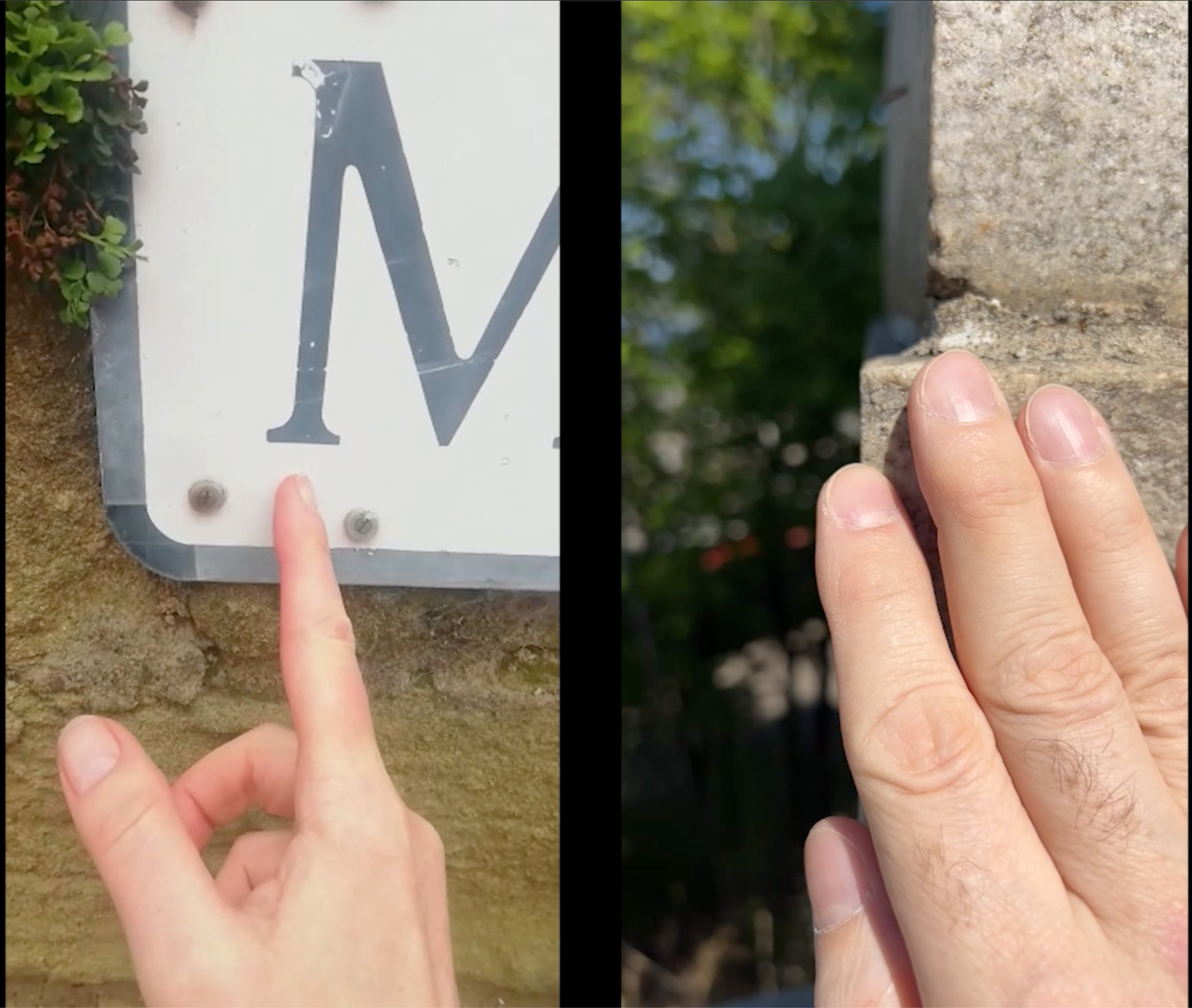
This project explores how we can create new geographies of the mind by collaboratively exploring our local environments slowly, at a very small scale, and by hand rather than on foot. Working together, artists Chris Kaczmarek and Deirdre Macleod each recorded, using Whatsapp, a sequence of concurrent haptic walks in which each artist draws attention

This project explores how we can create new geographies of the mind by collaboratively exploring our local environments slowly, at a very small scale, and by hand rather than on foot.

Working together, artists Chris Kaczmarek and Deirdre Macleod each recorded, using Whatsapp, a sequence of concurrent haptic walks in which each artist draws attention to a very small part of their surroundings using their hands. The first artist made a very short film and sent it to the second artist via Whatsapp. The second artist chose an element of their surroundings which they felt connects visually to the first artist’s film, and sent their film back to the first artist via Whatsapp. The sequence of films grew as each artist responded to the other’s films.

In contemporary life, we use many digital and mobile technologies such as GPS or Google Maps to navigate and represent the world. These images generated by these technologies are often considered to be ‘truthful’ representations of our environment because they are based on large scale geographical data. In contrast, slow-moving, close-up film-making is regarded as an unreliable representation of reality and, more significantly, futile as we cannot practically navigate the world in such a way.

Our project seeks to challenge ideas about how we can know the world through walking. The process of making and, crucially, sending these short films so that they can be viewed by the other person in a different geographical location enables each artist to create, in their own mind, a hybrid, imaginary place which combines their own memories of the space in which they have been working with partial and selective images of the space in which their artist collaborator is working. We believe that such hybrid geographies of the mind can create new and deep artistic knowledge.

Credits

This work was co-created by the following artists:
Christopher Kaczmarek
Deirdre Macleod

APA style reference

Kaczmarek, C., & Macleod, D. (2023). TRACE: A Remote Geography of the Mind. walk · listen · create. https://walklistencreate.org/walkingpiece/trace-a-remote-geography-of-the-mind/
Christopher Kaczmarek

Christopher Kaczmarek

(United States) 
Deirdre Macleod

Deirdre Macleod


One thought on “TRACE: A Remote Geography of the Mind

twalking

Walking and talking (often employed during a walkshop).

Added by Stephen Hodge
Problem?

Encountered a problem? Report it to let us know.

  • Include the page on which you encountered the problem.
  • Describe what happened.
  • Describe what you expected to happen.
Follow us