
This audio walk has been adapted from an interview undertaken on a blustery day in September 2008 from the catalogue of Talking Walking podcasts – freely available to listen to and download, Talking Walking has interviews with artists, activists and professionals from the world of walking.
Walk with the Mayor: Bristol’s Brunel Mile has been produced for “Walk in your Pocket” – one of many events taking place in Bristol over the weekend of the 11th – 15th September 2013 as part of the Walking in the City project.
My name is Andrew Stuck and you will hear my voice as I ask questions about the Brunel Mile, with George and Richard giving some intriguing answers.
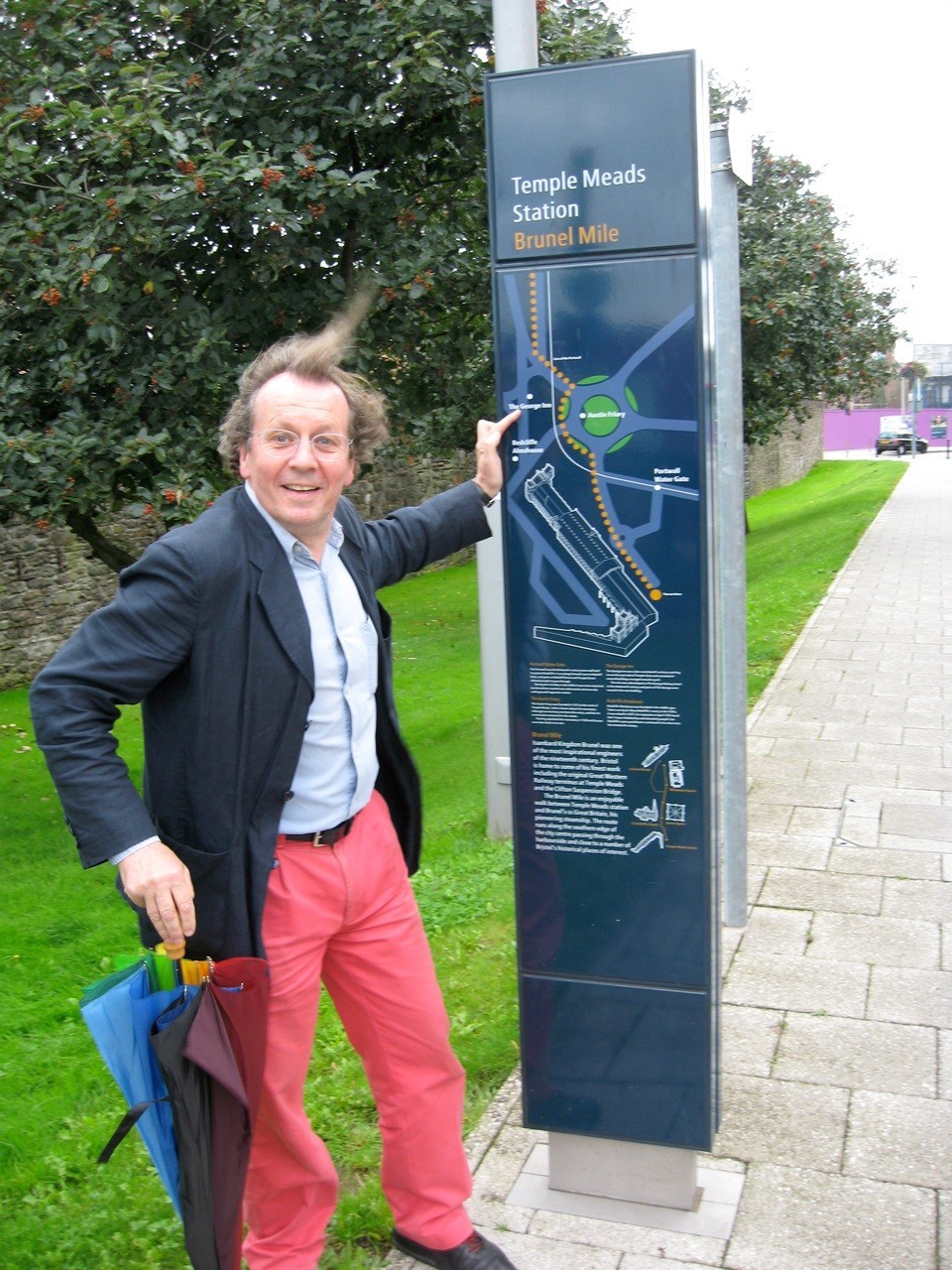
The route you need to take is fairly straightforward. To reach the point at which the interview begins, you need to get to a point on Temple Quay beside the wall of Temple Meads railway station – it is marked by a vertical sign [see the photo above].
This podcast was not designed as a guided route commentary –
what you hear is a conversation, at times describing things
along the route that aren’t necessarily at the point at which you
have reached. You may want to stand still when listening or
stroll along – just be aware that you will be crossing roads and in
places your route will be shared with others, sone on foot, some on bikes and occasionally cars too. So mind how you go. However, we hope the listening experience will be absorbing and fun.
Brunel Mile: Conceived as a millennium project, the Brunel Mile links Bristol Temple Meads station with Canon’s Marsh via the Port wall and Harbourside. Designed as an environmental route for walkers and cyclists, it celebrates the engineering achievements of Isambard Kingdom Brunel, who built the Great Western Railway from London Paddington to Bristol. His vision was to devise an integrated transport link from London to New York, whereby rail passengers would alight at Temple Meads, stay overnight at the Brunel Hotel and then embark on the Steam Ship Great Britain – now restored and berthed in the dry dock at the end of the Brunel Mile.
A few instructions will be given by me as you listen to the podcast. Let’s get started – you want to set off towards St Mary’s Redcliffe – the church’s spire is your distant landmark. Take care when crossing Redcliffe Way.
[5’20] Portwall is a name of a street that we want you to walk beside – just in case you haven’t found your way there yet. When you reached the roundabout as you leave Temple Quay, bear left (clockwise) around the roundabout, following the second main road Redcliffe Way. Cross to the far side of Redcliffe Way and continue to your left. Keep an eye out for a gap in the buildings on your right, until you see a view of St Mary’s church spire in the distance, turn right here to continue towards Portwall.
[9’59] Cross the harbour on the Redcliffe Road bridge to continue into Queen’s Square – keep straight keeping the square to your right.
[15’13] Emerge from Queen’s Square and walk across the harbour on Pero’s Bridge and enter Millennium Square
[19’25] Continue straight on – slightly downhill – between the new developments of Canon’s Marsh [20’54] You have come to the end of the Brunel Mile – why not take the ferry to visit the SS Great