Search
My feed
2016

Walled Ground, a Free Zone for Seedlings / a path is made by walking

Wolvenplein, Utrecht, Nederland

Sub-collection

Field recording

Sub-collection · 38 items

neighbourhood

Collection · 18 items

Prison

Collection · 4 items

Related

Sound walk

Exeter Sound Walks

Exeter Sound Walks is a series of illustrated, approximately one-mile walks created by Emma to explore and document the changing local soundscape over a year, with 24 walks planned for publication as a book. The walks emphasize attentive listening to seasonal and site-specific sounds, are designed for solitary or small group experiences, and include adaptations for diverse auditory perceptions.

Emma Welton
walkingevent

Promenade en balai supersonique; Op de bezem over de Bezemhoek

Enfourchez un balai de sorcière et « survolez » le Coin du Balai avec un casque audio sur les oreilles. Déambulez dans le quartier pendant une quarantaine de minutes et, sans quitter les rues, vous aurez l’impression de voler au-dessus des toits… Le balai enfourché diffusera la voix des habitants qui décrivent, chacun dans leur langue, la

Anne Versailles
Sound walk

Chorlton Oral History Soundwalk

Commissioned by North West Sound Heritage, sound artist Hayley Suviste created a geo-locative sound walk on Sonic Maps, using interviews from The Manchester Studies unit's extensive oral history project from the 1970s.

Hayley Suviste
walkingevent

Ian Rawes & The London Sound Survey: A celebration

An evening celebrating the life and work of field recordist Ian Rawes, founder of The London Sound Survey, who died in 2021.

Persistence of Sound
Sub-collection

Field recording

Sub-collection · 38 items

neighbourhood

Collection · 18 items

Prison

Collection · 4 items

Related

Sound walk

Exeter Sound Walks

Exeter Sound Walks is a series of illustrated, approximately one-mile walks created by Emma to explore and document the changing local soundscape over a year, with 24 walks planned for publication as a book. The walks emphasize attentive listening to seasonal and site-specific sounds, are designed for solitary or small group experiences, and include adaptations for diverse auditory perceptions.

Emma Welton
walkingevent

Promenade en balai supersonique; Op de bezem over de Bezemhoek

Enfourchez un balai de sorcière et « survolez » le Coin du Balai avec un casque audio sur les oreilles. Déambulez dans le quartier pendant une quarantaine de minutes et, sans quitter les rues, vous aurez l’impression de voler au-dessus des toits… Le balai enfourché diffusera la voix des habitants qui décrivent, chacun dans leur langue, la

Anne Versailles
Sound walk

Chorlton Oral History Soundwalk

Commissioned by North West Sound Heritage, sound artist Hayley Suviste created a geo-locative sound walk on Sonic Maps, using interviews from The Manchester Studies unit's extensive oral history project from the 1970s.

Hayley Suviste
walkingevent

Ian Rawes & The London Sound Survey: A celebration

An evening celebrating the life and work of field recordist Ian Rawes, founder of The London Sound Survey, who died in 2021.

Persistence of Sound
Sound walk
Since 2016, Hans van Lunteren and Ienke Kastelein have led monthly silent walks along a former prison wall in Utrecht to observe plant growth and explore the tension between control and natural development. Their ongoing project, Walled Ground, aims to create a permanent Free Zone for Seedlings, symbolizing ecological balance and freedom within an urban, controlled environment.

Walled Ground, a Free Zone for Seedlings / a path is made by walking
an ongoing project by Hans van Lunteren and Ienke Kastelein

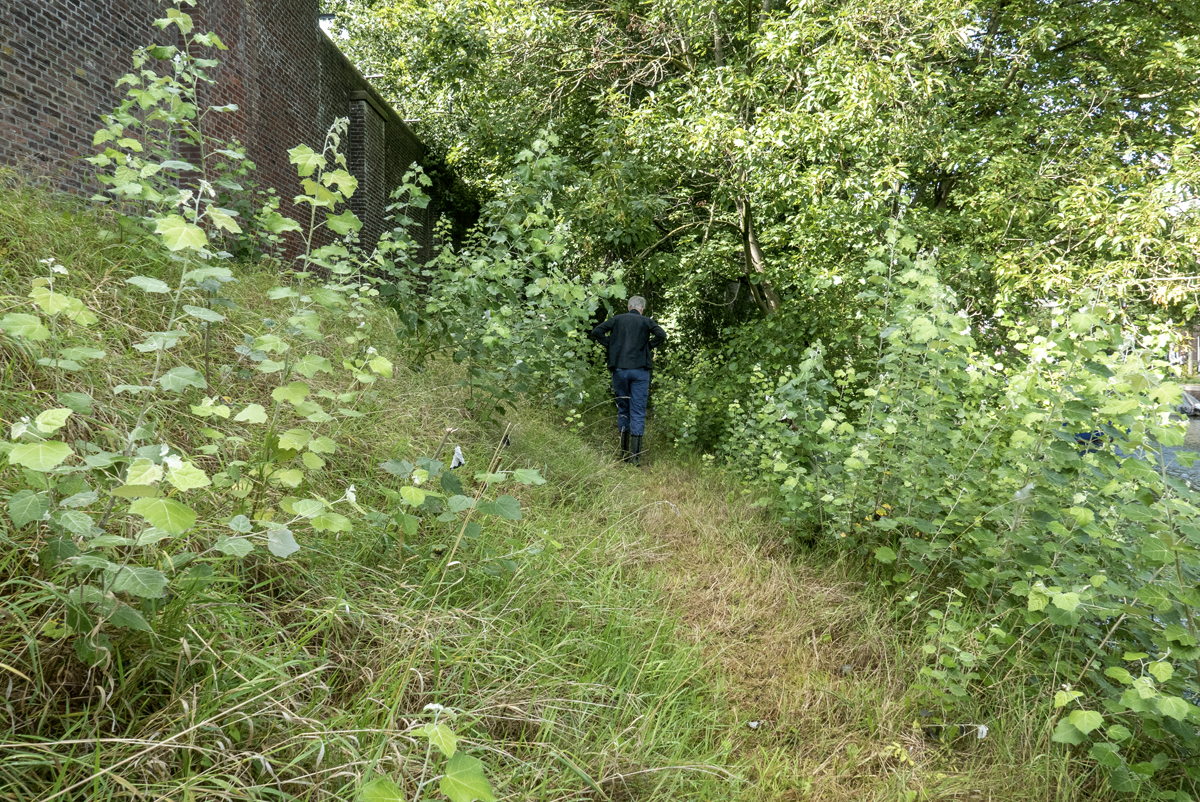
In 2016 we started an ecological project in the context of the exhibition Hacking Habitat in and around a former prison downtown the city of Utrecht (NL).
Every first Sunday of the month since we walk the area between the wall and a canal with a group of people engaging in the project. In going we walk the high path along a wall, always in silence – on coming back we share our observations on the growth of plants.
In the end we hope that this will result in a permanent Free Zone for Seedlings, where we as humans interact with other beings in an ecological balance.

On the September 6, 2020 we made a field recording during the walk.

Background
How can a seedling, a symbol of freedom, thrive in a prison where everything is tightly controlled? For Hacking Habitat, Hans van Lunteren and Ienke Kastelein examine this interface between captivity, systems, control and letting go.
We live in a world in which more and more is regulated and controlled. Is there still room for natural, spontaneous development? Can we occupy that space for ourselves? This current, urgent question is posed by Van Lunteren/Kastelein in the ecological project Walled Ground. Seedlings are an expression of freedom in a city where every square meter is occupied. A seedling hacks the city and together with the neighbourhood the artist develops an alternative ‘hack-your-way’-route around the Wolvenplein. By means of a choreographic walk, visitors can experience the interaction between captivity and freedom.
Every Sunday between March and June 2016 , people could join the choreographic walk.

https://hackinghabitat.com/en/persoon/hans-van-lunteren-ienke-kast/

1601235987.Bemuurde Grond sept 2020

CC-BY-NC: Ienke Kastelein

APA style reference

Kastelein, I. (2016). Walled Ground, a Free Zone for Seedlings / a path is made by walking. walk · listen · create. https://walklistencreate.org/walkingpiece/walled-ground-a-free-zone-for-seedlings-a-path-is-made-by-walking/

pedestrian acts

By de Certeau: In “Walking in the City”, de Certeau conceives pedestrianism as a practice that is performed in the public space, whose architecture and behavioural habits substantially determine the way we walk. For de Certeau, the spatial order “organises an ensemble of possibilities (e.g. by a place in which one can move) and interdictions (e.g. by a wall that prevents one from going further)” and the walker “actualises some of these possibilities” by performing within its rules and limitations. “In that way,” says de Certeau, “he makes them exist as well as emerge.” Thus, pedestrians, as they walk conforming to the possibilities that are brought about by the spatial order of the city, constantly repeat and re-produce that spatial order, in a way ensuring its continuity. But, a pedestrian could also invent other possibilities. According to de Certeau, “the crossing, drifting away, or improvisation of walking privilege, transform or abandon spatial elements.” Hence, the pedestrians could, to a certain extent, elude the discipline of the spatial order of the city. Instead of repeating and re-producing the possibilities that are allowed, they can deviate, digress, drift away, depart, contravene, disrupt, subvert, or resist them. These acts, as he calls them, are pedestrian acts.

Problem?

Encountered a problem? Report it to let us know.

  • Include the page on which you encountered the problem.
  • Describe what happened.
  • Describe what you expected to happen.
Follow us