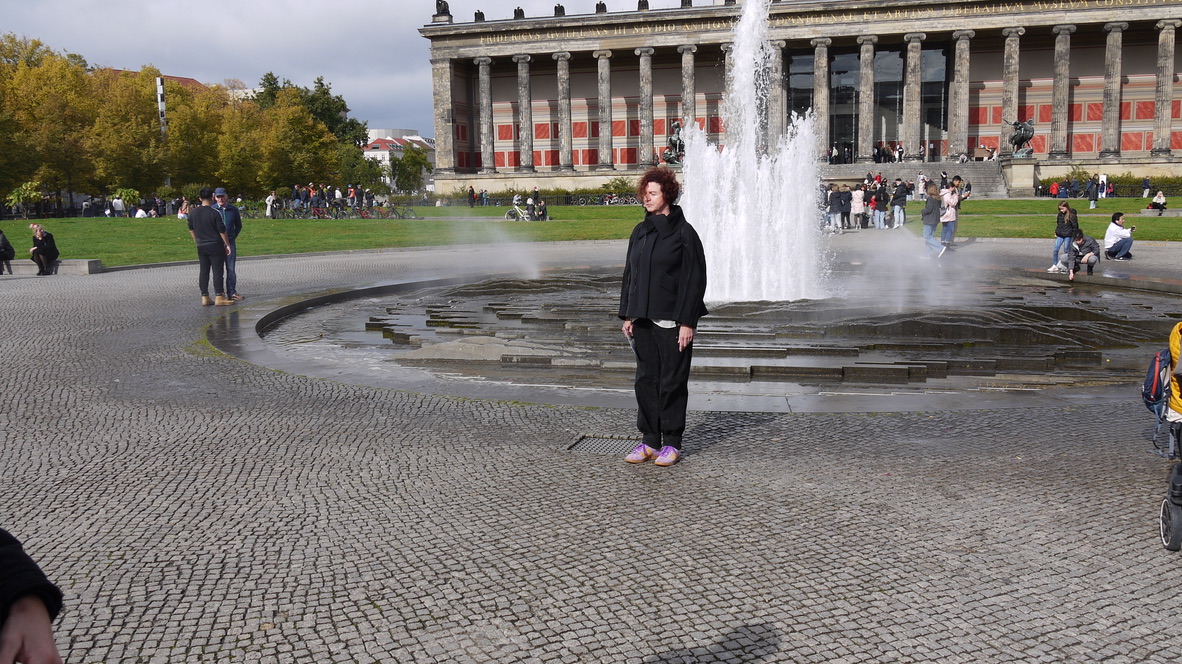
With SCHRITTWEISE, Katja Münker created a participatory performance in and with the city, allowing a choreography to emerge from small experiments with movement and perception, conducted while walking.
This walking piece is one of the shortlisted pieces in the Marŝarto Awards 2023. Here, Katja discusses her work.
SCHRITTWEISE is a participatory performance-intervention based on an audio-guide and a choreographic online toolkit for research and practice within the field of walking, inhabiting cities, and creating performative walks and walking performances.
The performance-intervention SCHRITTWEISE Choreographing City premiered September 2022 under the roof of Tanzfabrik Berlin in Lustgarten / Berlin. Since then, it was performed again in Henry-Ford-Bau / Freie Universität Berlin and on Washington-Platz in front of the main station Berlin. The audio-guide is designed for groups and free adaptably to city-places without car-traffic.
The choreographic toolkit SCHRITTWEISE Choreographing Walking is based on the fundus of all somatic and choreographic material that was collected and tested during the development of the performance-intervention SCHRITTWEISE – Choreographing City together with the SCHRITTWEISE team, with research-lab participants and test walkers. This fundus was evaluated and organized by me in close cooperation with Andrea Keiz and Paula Kramer from the team after the first series of 4 performances in September 2022. The intention of this re-organisation-process was to finally provide a range of basic strategies for choreographic processes in and with walking and therefore to assemble experiments and scores, questions and observations that accompany and stimulate choreographic practices and processes.


Details
On the project’s website, both the documentation of the performance interventions SCHRITTWEISE and the choreographic construction-play-kit are now available as open source for choreographic studies, researches and works.
The website is available in German and English, and it is organised starting from one main-page into two intertwined threads for the two content-components, like a two-in-one webpage. And both website-layers are interlinked with cross-references.
On the main page the link Choreographing City leads to the documentation, which will be actualized with further adaptations made for different city-places. This thread also includes some background-information on the artistic practice of documentation itself.
The link Choreographing Walking on the main page leads to the free choreographic construction-play-kit available for choreographic studies, researches and works with a collection of walking experiments, questions, and observations in 5 chapters: body, place, time, perception and documentation.
The website was realised by Andrea Keiz and co-designed by the both of us based on the experience, material and evaluation throughout the entire process and the documentation material. The website is built on already existing online-publication tools for dance and artistic research:
The starting page and the thread Choreographing City is using MoSys & Grids by Motion Bank Web Systems, a choreographic publishing system evolved from a simple site builder to a multimodal annotation tool.
The thread Choreographing Walking is using the research catalogue, an international database for artistic research and a non-commercial, collaboration and publishing platform for artistic research provided by the Society for Artistic Research.
SCHRITTWEISE was funded and premiered in collaboration with Tanzfabrik Berlin on the very famous City-place Lustgarten in Berlin Mitte during the COVID Pandemic. This specific walking performance is informed by my artistic work with and in walking since 2009. The choreographic framework of SCHRITTWEISE Choreographing City was developed within a team: Paula Kramer (production management & artistic collaboration), Maxim Kares (dramaturgy), Andrea Keiz (documentation & artistic collaboration), Andreas Harder (technical direction & artistic collaboration), and Mattef Kuhlmey (sound design). The concept for the participatory performance could only be realised through numerous test-runs with numerous voluntary participants.


Background & Intentions
The intention was to establish a collective aesthetic space, especially in times characterised by social and physical distancing due to COVID-19 and the social controversies around that, which leaves and creates space for individual orientation and communal interaction in the same way: in a non-verbal aesthetic field of attention, perception and action, differences and synchronicities are invited to coexist and communicate on the basis of aesthetic experience: physical self-experience and self-organisation in the frame of the audio-walk, the overall performative gestalt and the references to other players, passers-by and the city-location.
The basis for the audience’s activities and for the framing and realisation of the performance are audio-verbal instructions that work on walking as a choreographic field of expression. Concrete fields of action are created via short descriptions of play and research, inviting the audience to individual interpretation and co-creation.
My choreographic approach is based on somatics (the practice, knowledge and art of conscious perception, exploration and utilisation of the sensing and sensed body) and the assumption from embodied cognition theories, that perception and sense-making develop from perceived bodily situatedness and interaction with our environment.
With SCHRITTWEISE I was interested to develop an easily accessible framework for somatic-choreographic experiments in and with the city, inviting people to fill and shape life in the city with and through the sensing body.

Resonances & Reflections
The feedback from test walkers and audience participants was generally positive. For many participants, the framework of the performance intervention enabled a more relaxed and open presence in public space than under everyday conditions. Many also experienced challenging circumstances such as noise, unrest, architectural roughness or many people with more ease and playfulness and discovered unusual behaviours in the process. Aesthetic and somatic perception and experiments within the framework of the audio walk seem to have a calming and at the same time attentive effect on the relationship of the listening-interacting individuals to the social environment.
In this sense, SCHRITTWEISE seems to generate a self-guiding and self-efficacy-supporting potential via the choreographic framing, which opens creative leeway.
The winners and honourable mentions of the Marŝarto Awards 2023 will be announced in early 2024.