Search
My feed

A Sound Walk, together

Emma Welton

On
Saturday 19th September
at 3pm

A SOUND WALK, together
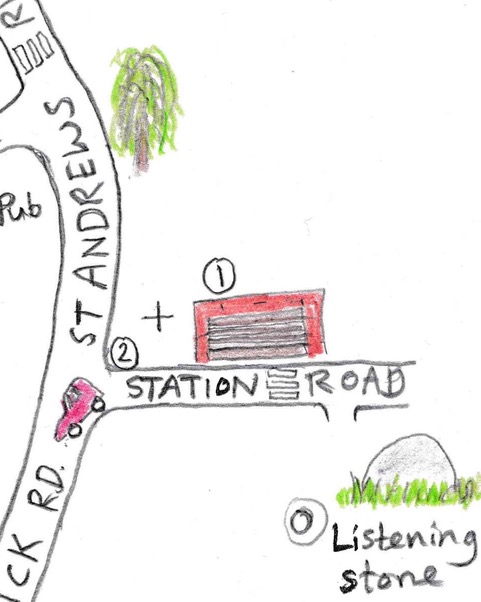
in Exwick, Exeter, UK

group of 3 + Emma Welton
about an hour
a short, circular walk, with pauses

very local
minimal conversation
listening together

helping each other to attend to what’s there

If you would like to come, send me a message.

In the case of bad weather, the walk will be postponed.

This event has happened

2020-09-19 14:00
2020-09-19 14:00
2020-09-19 14:00

Exwick, Exeter, UK

Walking Together

Collection · 16 items

Related

Sound walk

An Evening Symphony, with Barbed Wire

A Sound Walk podcast conversation. Composer Emma Welton walks, listens and talks with artist Volkhardt Müller an Exeter-based multidisciplinary artist with a professional interest in landscape, how people shape it and how it shapes people.

Emma Welton
walkingevent

Contested developments in Peckham: A Practical Listening walk

Listening walk through housing estates that face redevelopment

Andrew Stuck
walkingevent

Über die unerträgliche Vieldeutigkeit des Seins (Finissage)

Finissage of the Soundwalk|Exhibition “Über die unerträgliche Vieldeutigkeit des Seins”

Hendryk
walkingevent

Exeter Sound Walks

Sound Walks, together, in Exeter in May and June.

Emma Welton
walkingevent

Exeter Sound Walks

Sound Walks, together, in Exeter in May and June.

Emma Welton

pedestrian acts

By de Certeau: In “Walking in the City”, de Certeau conceives pedestrianism as a practice that is performed in the public space, whose architecture and behavioural habits substantially determine the way we walk. For de Certeau, the spatial order “organises an ensemble of possibilities (e.g. by a place in which one can move) and interdictions (e.g. by a wall that prevents one from going further)” and the walker “actualises some of these possibilities” by performing within its rules and limitations. “In that way,” says de Certeau, “he makes them exist as well as emerge.” Thus, pedestrians, as they walk conforming to the possibilities that are brought about by the spatial order of the city, constantly repeat and re-produce that spatial order, in a way ensuring its continuity. But, a pedestrian could also invent other possibilities. According to de Certeau, “the crossing, drifting away, or improvisation of walking privilege, transform or abandon spatial elements.” Hence, the pedestrians could, to a certain extent, elude the discipline of the spatial order of the city. Instead of repeating and re-producing the possibilities that are allowed, they can deviate, digress, drift away, depart, contravene, disrupt, subvert, or resist them. These acts, as he calls them, are pedestrian acts.

Problem?

Encountered a problem? Report it to let us know.

  • Include the page on which you encountered the problem.
  • Describe what happened.
  • Describe what you expected to happen.
Follow us